How does Planck's law resolve the ultraviolet catastrophe predicted by classical physics? Calculate the average energy \bar{\varepsilon} of an oscillator of frequency 0.60 \times 10^{14}\text{ s}^{-1} at T = 1800\text{ K}, treating it as (i) classical oscillator and (ii) Planck's oscillator.
In spherical coordinates, V = -25\text{ V} on a conductor at r = 2\text{ cm} and V = 150\text{ V} on another conductor at r = 35\text{ cm}. The space between the conductors is a dielectric for which \varepsilon_r = 3.12. Find the surface charge densities on the conductors.
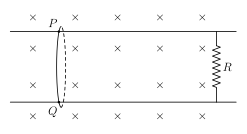
Consider a situation shown in the figure below. The wire PQ has mass m, resistance r and can slide on the smooth, horizontal parallel rails separated by a distance l. The resistance of rails is negligible. A uniform magnetic field B exists in the rectangular region and a resistance R connects the rails outside the field region. At t = 0, the wire PQ is pushed towards right with a speed V_0. Find (i) the current in the loop at an instant when the speed of the wire PQ is V and (ii) the acceleration of the wire at this instant :
Consider a uniformly magnetized sphere of radius a and magnetization \vec{M} = M_0 \hat{z} surrounded by a vacuum region. Obtain an expression for scalar magnetic potential for r < a.
Using Maxwell's equations, obtain Poisson's equation and Laplace's equation. The region -\frac{\pi}{2} < \frac{z}{z_0} < \frac{\pi}{2} has a charge density \rho = 10^{-8} \cos \left( \frac{z}{z_0} \right) (\text{C/m}^3). Elsewhere the charge density is zero. Find the electric potential V and electric field E from the Poisson's equation.
Obtain the general boundary conditions for fields E, B, D and H at a boundary between two different media carrying charge density \sigma or a current density K.
The magnitude of the average electric field normally present in the Earth's atmosphere just above the surface of the Earth is about 150\text{ N/C}, directed radially inward, toward the centre of the Earth. What is the total net surface charge carried by the Earth? Assume the Earth to be a conductor. (The radius of the Earth is 6.37 \times 10^6\text{ m})
Find the magnetic field strength (H) at the centre of a square current loop of side L.
What is anomalous dispersion? How does the phenomenon of dispersion lead to the separation of white light into its constituent colours?
A uniform plane wave with \vec{E} = E_x \hat{a}_x propagates in a lossless medium (\varepsilon_r = 4, \mu_r = 1, \sigma = 0) in the z-direction. Assume that E_x is sinusoidal with a frequency 100\text{ MHz} and has a maximum value of 10^{-4}\text{ (V/m)} at t = 0 and z = \frac{1}{8}\text{ (m)}. (i) Write the expression for instantaneous E for any t and z. (ii) Write the expression for instantaneous H. (iii) Determine the locations where E_x is a positive maximum, when t = 10^{-8}\text{ (s)}.
Show that Continuity equation is embedded in Maxwell's equations.
Two charges Q_1 = 3\text{ nC} and Q_2 = 4\text{ nC} are placed at the cartesian points (0, 2, 2)\text{ m} and (0, -2, 4)\text{ m}, respectively. The z = 0 plane is connected to the ground. Calculate the electric potential and the electric field at the point (3, 2, 4)\text{ m} using the method of images.
A circular ring of radius R lying on the x-y plane and centred at the origin, carries a uniform line charge \lambda. Find the first three terms (monopole, dipole and quadrupole) of the multipole expansion of potential V(r, \theta).
A neutral atom consists of a point nucleus +q surrounded by a uniformly charged spherical cloud (-q) of radius r. Show that when such an atom is placed in a weak external electric field \vec{E}, the atomic polarizability of the atom is proportional to the volume of the sphere.
Two inductors having inductances L_1 and L_2 are connected in parallel. The inductors have a mutual inductance M. Derive the expression for the effective inductance. Assume the inductors have negligible resistances.
Derive the expression for the inductance per unit length of two long parallel wires each of radius a, separated by distance d from their axes and carrying equal and opposite current I.
Find the energy stored in a system of four charges Q_1 = 1\text{ nC}, Q_2 = 2\text{ nC}, Q_3 = 3\text{ nC} and Q_4 = 4\text{ nC} placed at the cartesian coordinates R_1(1, 1), R_2(2, 1), R_3(1, 4) and R_4(2, 2), respectively. Assume free space.
A spherical shell of radius R, carrying a uniform surface charge \sigma, is set spinning at angular velocity \omega about its axis. Find the vector potential it produces at point \vec{r}.
A metal guitar string with a length of 70\,\mathrm{cm} vibrates at its fundamental frequency of 246.94\,\mathrm{Hz} in a uniform magnetic field of 10\,\mathrm{T} oriented perpendicular to the plane of vibration of the string. Assume a sinusoidal form for the amplitude of the vibrational mode, and a maximum displacement of 3\,\mathrm{mm} at the centre of the string. What is the maximum e.m.f. generated across the length of the guitar string, and at what point in time in the string's motion does that occur? What would be the e.m.f. if the same guitar string vibrates at its second harmonic frequency? Briefly explain.
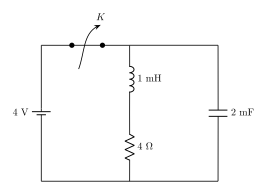
Consider the R-L-C circuit shown here. Calculate the Q-factor of the circuit. Does the circuit have a resonant frequency? Justify your answer: