A cell of internal resistance 1\,\text{ohm}, 1.5 volt e.m.f. and another cell of internal resistance 2\,\text{ohm}, 2 volt e.m.f. are connected in parallel across the ends of an external resistance of 5\,\text{ohm}. Find the current in each branch of the circuit.
Starting from the Laplace's equation in a cylindrical polar coordinate system and using the method of separation of variables, obtain the differential equations for the solutions of r, \phi and z components of the potential.
In a partially conducting medium, \varepsilon_r = 18.5, \mu_r = 800 and \sigma = 1\ \mathrm{S\,m^{-1}}. Find \alpha, \beta, \eta and the velocity u, for a frequency of 10^9\ \mathrm{Hz}. Determine \vec{H}(z,t). Given, \vec{E}(z,t) = 50e^{-\alpha z}\cos(\omega t - \beta a_z)a_y\ \mathrm{V\,m^{-1}}.
Consider two point particles of charge q each, separated by a distance d, and travelling at non-relativistic velocity \vec{v}. If the line joining the two charges is perpendicular to \vec{v}, then write an expression for the magnetic force between the two particles, and illustrate the direction of the force on each particle.
Write down Maxwell's equations in a non-conducting medium with constant permeability and susceptibility (\rho = j = 0). Show that \vec{E} and \vec{B} each satisfies the wave equation, and find an expression for the wave velocity. Write down the plane wave solutions for \vec{E} and \vec{B}, and show how \vec{E} and \vec{B} are related.
A current sheet having \vec{K} = 9.0a_y\,\mathrm{A\,m^{-1}} is located at z = 0. The interface is between the region 1, z < 0, \mu_{r1} = 4, and region 2, z > 0, \mu_{r2} = 3. Given that \vec{H}_2 = 14.5a_x + 8.0a_z\,\mathrm{A\,m^{-1}}. Find \vec{H}_1 and \vec{B}_1.
Calculate the skin depth of electromagnetic waves of 1\,\mathrm{MHz} incident on a good conductor having \sigma = 5.8 \times 10^{7}\,\mathrm{S\,m^{-1}}. Assume that inside the conductor \mu = \mu_0 = 4\pi \times 10^{-7}\,\mathrm{H\,m^{-1}}.
The spectral composition of solar radiation is similar to that of a black body radiator whose maximum emission corresponds to the wavelength 0.48\,\mu\mathrm{m}. Find the mass lost by the Sun every second due to radiation. Evaluate the time interval during which the mass of the Sun reduces by 1 per cent. Given: Stefan Boltzmann constant = 5.669 \times 10^{-8}\ \mathrm{W\,m^{-2}\,K^{-4}}, radius of the Sun = 6.957 \times 10^{8}\ \mathrm{m}, surface temperature of the Sun = 5772\ \mathrm{K} and mass of the Sun is 1.9885 \times 10^{30}\ \mathrm{kg}.
A region 1, z<0, has a dielectric material with \varepsilon_r=3.2 and a region 2, z>0 has a dielectric material with \varepsilon_r=2.0. Let the displacement vector in the region 1 be, \vec{D}_1=-30a_x+50a_y+70a_z\,\mathrm{nC\,m^{-2}}. Assume the interface charge density is zero. Find in the region 2, the \vec{D}_2 and \vec{P}_2, where \vec{P}_2 is the electric polarization vector in the region 2.
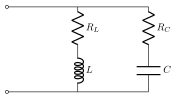
Consider the two branch parallel circuit shown in the diagram. Determine the resonant frequency of the circuit.
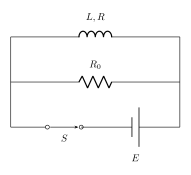
In the given circuit, L=2.0\,\mu\mathrm{H}, R=1.0\,\Omega, R_0=2.0\,\Omega and E=3.0\,\mathrm{V}. Find the amount of heat generated in the coil after the switch S is disconnected. The internal resistance of the source is negligible.
Given that the electric potential of a system of charges is V=\dfrac{12}{r^2}+\dfrac{1}{r^3} volt. Calculate the electric field vector at the Cartesian point (4,2,3)\,\mathrm{m}.
A rod of length l is perpendicular to a uniform magnetic field \mathrm{B}. The rod revolves at an angular speed \omega about an axis passing through one end of the rod and parallel to the magnetic field \mathrm{B}. Find the voltage induced across the rod's ends.
Given an infinite line charge of charge density 2\,\mathrm{nC\,m^{-1}} parallel to the y-axis and passing through the point (3,0,4)\,\mathrm{m} and an infinite sheet of charge of charge density 4\,\mathrm{nC\,m^{-2}} parallel to the x-y plane and passing through the point (0,0,6)\,\mathrm{m}. Calculate the electric field intensity at the point (10,10,10)\,\mathrm{m}. Assume free space.
Using the two-fluid model of a conductor (normal and superconducting) and the Maxwell's equations, derive the two London equations of superconductivity.
For the electric field given by E=E_0e^{i\omega t}, show that the conduction current is in phase with the electric field, while the displacement current leads the electric field by \frac{\pi}{2} radians. Also, show that the displacement current in a good conductor is negligible compared to the conduction current at any frequency lower than the optical frequencies (f<10^{15}\ \mathrm{Hz}).
Write Maxwell's equations in free space in both differential and integral forms. Obtain wave equations and show that electromagnetic waves can travel in free space with a speed of light. Can one get the wave equations from the integral form of the Maxwell's equations?
Describe the oscillations of electric and magnetic fields in an ideal LC circuit. The applied voltage phasor in a circuit is (4+3i) volt and resulting current phasor is (3+4i) ampere. Draw the phasor diagram. Determine the impedance of the circuit and indicate whether it is inductive or capacitive in nature. Also find the power dissipation in the circuit.
Write expressions for divergence and curl of an electrostatic field. From these, obtain Poisson and Laplace equations. Two concentric conducting spherical shells having radii r_1 and r_2 (r_1<r_2) are charged to potentials V_1 and V_2, respectively. What are the electric potential and hence electric field in the space between the shells? Also find the charge on the inner shell.
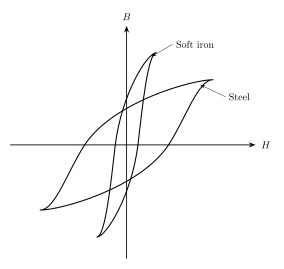
Based on the hysteresis loops for soft iron and steel as shown in the diagram, which material would you prefer to utilise for making transformer cores and why?