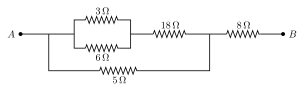
Calculate the effective resistance of the following combination of resistances as shown in the figure and determine the voltage drop across each resistance when a potential difference of 120\text{ volts} is applied between points A and B :
10 Marks
Calculate the effective resistance of the following combination of resistances as shown in the figure and determine the voltage drop across each resistance when a potential difference of 120\text{ volts} is applied between points A and B :
The space between the plates of a parallel-plate capacitor is filled with a dielectric material whose susceptibility varies linearly from 0 at the bottom plate (x = 0) to 1 at the top plate (x = d). The capacitor is connected to a battery of voltage V. Calculate all the bound charges and check that the total charge is zero. Assume that the battery is connected in such a way that the electric field points along the x-direction while the free charge density, \sigma_f, is positive at the bottom plate and negative at the top plate.
A charge of -3\cdot 30\text{ }\mu\text{C} is fixed at a point. From a horizontal distance of 0\cdot 0455\text{ m}, a charged particle of mass 7\cdot 35 \times 10^{-3}\text{ kg} and charge -7\cdot 45\text{ }\mu\text{C} is fired with an initial velocity 62\cdot 5\text{ m/s} directly towards the fixed charge. How far does this charge travel before its speed becomes zero?
A very long solenoid of radius a, with n turns per unit length, carries a current I_s. Coaxial with the solenoid, at radius b \gg a, is a circular ring of wire with resistance R. When the current in the solenoid is gradually reduced, a current I_r is induced in the ring. Calculate I_r in terms of \frac{dI_s}{dt}. Also, calculate the power dissipated through Joule effect and the electric field \vec{E} near the solenoid.
Blackbody radiation in a cavity at 2000\text{ K} is subject to isothermal reversible expansion through 10^3\text{ cm}^3. Calculate (i) the heat transferred and (ii) the work done. If the initial volume was 10\text{ cm}^3 and expansion had been adiabatic, calculate the change in temperature of the radiation. (Given, Stefan--Boltzmann constant, \sigma = 5\cdot 672 \times 10^{-8}\text{ J}\cdot\text{m}^{-2}\cdot\text{K}^{-4}\cdot\text{s}^{-1})
A wire of length 2\text{ m} is perpendicular to the X\text{--}Y plane. It is moved with velocity \vec{V} = 2\hat{i} + 3\hat{j} + \hat{k}\text{ m/s} through a region of uniform magnetic induction \vec{B} = \hat{i} + 2\hat{j}\text{ Wb/m}^2. Compute the potential difference induced between the ends of the wire.
Discuss the origin of hysteresis in ferromagnetic materials on the basis of domain theory. Explain how domain wall motion and pinning lead to energy loss during cyclic magnetization.
The magnetic field H of an electromagnetic wave travels in the -a_z direction in free space with a phase shift constant of 30\text{ rad/m} and an amplitude of \left(\frac{1}{3\pi}\right)\text{ A/m}. If the field has the direction -a_y when t = 0 and z = 0, write the suitable expressions for E and H. Determine the frequency and wavelength of the wave.
In a homogeneous non-conducting region where \mu_r = 1, find \epsilon_r and \omega, if \begin{align*} \vec{E} &= 30\pi e^{j[\omega t - (4/3)y]} \vec{a}_z \quad (\text{V/m}) \ \vec{H} &= 1\cdot 0 e^{j[\omega t - (4/3)y]} \vec{a}_x \quad (\text{A/m}) \end{align*}
A parallel plate capacitor having circular plates of radius 10\text{ cm} is being charged. If the electric field at any instant within the capacitor changes at the rate 5\cdot 0\text{ V m}^{-1}\text{ s}^{-1}, calculate the magnetic intensity |\vec{H}| inside the capacitor.
As shown in the figure, a series circuit connected across a 200\text{ V}, 60\text{ Hz} line consists of a capacitor of capacitive reactance of 30\ \Omega, a non-inductive resistor of 44\ \Omega and a coil of inductive reactance 90\ \Omega and resistance 36\ \Omega.
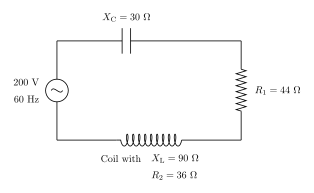
Determine : (i) Power factor of the circuit (ii) Power absorbed by the circuit (iii) Power dissipated in the coil
State and explain Kirchhoff's current law and Kirchhoff's voltage law. Derive these laws from the principles of charge conservation and energy conservation.
A rectangular coil consists of 50 closely wrapped turns and has dimensions of 0\cdot 5\text{ m} \times 0\cdot 4\text{ m}. It carries a current of 1\cdot 5\text{ A}. If a uniform magnetic field B = 0\cdot 1\text{ T} is applied such that the direction of the magnetic field makes an angle of 60^\circ with respect to the plane of the coil, what is the torque exerted on the coil by the magnetic field?
Consider a conducting sphere of radius ‘a’ in a uniform electric field \vec{E}. Find the induced surface charge density on the sphere and determine the electric field \vec{E} at a point P characterized by radius vector \vec{r}.
\vec{E} = 10 \cos (\omega t - 100 x) \hat{j}\text{ V/m} In free space, an electric field (\vec{E}) is given by the following expression : \vec{E} = 10 \cos (\omega t - 100 x) \hat{j}\text{ V/m} Find the angular frequency \omega and the displacement current.
Show that the electromagnetic wave equation is invariant under Lorentz transformations.
Consider a point charge of 5\text{ nC} placed at a distance of 1\text{ m} from a perfect conducting plane (z = 0) of infinite extent. Find the electric field at a point (2, 2, 0)\text{ m} and show that it is normal to the plane.
Consider a long straight wire of length L carrying a current I. Determine the magnetic vector potential \vec{A} at a point P located at distance x from the wire.
An electromagnetic wave has its magnetic field |\vec{B}| = 55 \times 10^{-8}\text{ T}. Determine the magnitude of the Poynting vector.
Derive the Planck's radiation law for blackbody radiation using the Bose-Einstein distribution function. Explain how results from quantum statistics differ from classical results derived from the Rayleigh-Jeans law.