What is the recoil energy in electron-volts of a nucleus of mass 10^{-23}\text{ gm} after emission of x-ray of energy 1\text{ MeV}?
20 Marks
What is the recoil energy in electron-volts of a nucleus of mass 10^{-23}\text{ gm} after emission of x-ray of energy 1\text{ MeV}?
What is understood by the term ‘Coriolis force’? Obtain expressions for velocity and acceleration of a particle in rotating coordinate systems.
A vessel of mass 10^7\text{ kg} is gyrostabilised by a uniform circular disc of mass 5\times 10^4\text{ kg} and radius 2\text{m} which rotates at 15\text{ rev/sec}. What is the angular momentum of the stabilizer ?
What is the angular momentum (referred to the centre of the orbit) of a satellite of mass M, which moves round the earth in a circular orbit of radius r? The result is to be expressed in terms only r, G.M, and M_e (the mass of the earth).
Show from the Lorentz transformation that two events (t_1=t_2) at different points (x_1 \neq x_2) in reference frame S are not in general simultaneous in reference frame S which is moving in the + direction with the constant velocity V with respect to S.
Write a short note on Motion of rocket under constant force field.
Two objects (M_1=2\text{ gm}: M_2=5\text{ gm}) process Velocities V_1= 10\hat{x}\text{ cm/sec}, V_2 = 3\hat{x}+ 5\hat{y}\text{ cm/sec} just prior to a collision during which they become permanently attached to each other. What is the final momentum of combination of the laboratory system ?
What is the momentum of a proton having kinetic energy 1\text{ BeV} ? The energy equivalent to proton rest mass is 0.938\text{ BeV}.
The mean distance of the Earth from the Sun is 1.496 \times 10^{11}\text{ m}, while that of Saturn is 1.427 \times 10^{12}\text{ m}. Find the time taken by Saturn to complete one revolution round the Sun.
Find the linear acceleration of the center of gravity of a uniform disc which rolls down an inclined plane without slipping. The angle of inclination is 30^\circ.
A steel ball 1.00\text{ mm} in diameter falls at a constant speed of 0.176\text{ cm s}^{-1} in a large vessel filled with oil. Calculate the dynamic viscosity of the oil (Density of steel = 7,700\text{ kg/m}^3 density of oil = 900\text{ kg/m}^3).
Write a note on Predictions of general theory of relativity and their experimental verification.
A muon (\mu meson) is for med high up in the atmosphere and travels towards the earth with a speed of 0.992\text{ c}. It decays af ter travelling a distance of 6.0\text{ km}. In what time does the muon decay as measured (i) by us and (ii) in its own frame of reference? What is the distance covered the muon in its own frame of reference?
Show that the kinetic energy T of relativistic particle moving with momentum p is T = P^2 / m + m_0 What m_0 its rest mass and m is its relativistic mass.
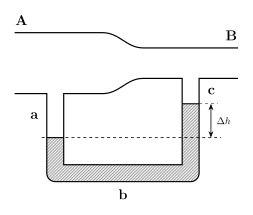
Air is blown through a pipe AB, at a rate of 15\text{ litres per minute}. The area of cross-section at A is 2\text{ cm}^2 whereas at B it is 0.2\text{ cm}^2. A tube abc, containing some water, is connected as shown. Find the difference in height, \Delta h, between the levels of water in the tube abc.
Find the expression for the rise of a liquid between two parallel plates separated by a distance t and dipped vertically in the liquid.
For an isotropic solid define Young's modulus of elasticity Y, coefficient of rigidity \eta and Poisson's ratio \alpha. Establish the relation. \sigma = \frac{Y - 2\eta}{2\eta}
Write a note on Coriolis force and its manifestations.
n identical drops of water, each of radius r_{2}, coalesce to form a large drop of radius R. Calculate the energy released in the process and the consequent rise in temperature of water.
Calculate the mass of the Sun, given the distance of the Earth from the sun to be 1.5 \times 10^{8}\text{ km}.