Briefly discuss the Kepler's laws of planetary motion.
5 Marks
Briefly discuss the Kepler's laws of planetary motion.
State and explain the Hooke's law of elasticity. Briefly discuss the features of stress-strain diagram for the behaviour of a wire undergoing increasing stress.
Show that the kinetic energy of a system of n particles is given by T = \frac{1}{2} M V_{\text{cm}}^2 + \frac{1}{2} \sum_{i=1}^n m_i {V'_i}^2 where M is the total mass, V_{\text{cm}} is the velocity of the centre of mass, V'_i is the velocity of the particles about the centre of mass and m_i is the mass of the i\text{th} particle.
What are the consequences of Lorentz transformations on length and time when observed from a frame moving at relativistic velocities ?
Define streamline flow of a fluid. Using the equation of continuity for an isotropic fluid, find different components of total energy per unit volume.
(i) Prove that the separation of two colliding particles is same, when observed in centre of mass and laboratory systems. (ii) Determine the kinetic energy of a thin disc of mass 0\cdot5\text{ kg} and radius 0\cdot2\text{ m} rotating with 100 rotations per second around the axis passing through its centre and perpendicular to its plane.
A force \vec{F} is given by \vec{F} = x^2 y \hat{x} + z y^2 \hat{y} + x z^2 \hat{z}. Determine whether or not the force is conservative.
(i) The quantities of rotatory motion are analogous to those of translatory motion. Write the corresponding equations of translatory and rotatory motion. (ii) Describe the theorems of perpendicular and parallel axes in case of a plane lamina.
Calculate the gravitational self-energy of the Earth. Given : Mass of Earth M_e = 6 \times 10^{24}\text{ kg} and the Radius of Earth R_e = 6\cdot4 \times 10^6\text{ m}
(i) Derive the expressions for gravitational potentials at a point (I) outside the spherical shell, (II) inside the spherical shell. (ii) Calculate the escape velocity of a body of mass 10\text{ kg} from the surface of Moon \left( g_{\text{Moon}} = \frac{1}{6} g_{\text{Earth}} \right). Mass of Moon = 7\cdot3 \times 10^{22}\text{ kg} Radius of Moon = 1\cdot7 \times 10^6\text{ m}
Define moment of inertia and radius of gyration of a body of mass M rotating about an axis. State and prove Parallel Axis theorem on moment of inertia.
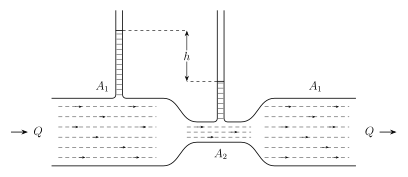
Consider the diagram below with a water flow rate Q. Derive the expression for Q in terms of the difference in the manometer heights h and the cross-section areas A_1 and A_2:
Show that for very small velocity, the equation for kinetic energy, K=\Delta mc^2 becomes K=\dfrac{1}{2}m_0v^2, where notations have their usual meanings.
Consider two frames of reference S and S having a common origin O. The frame S is rotating with respect to the fixed frame S with a uniform \vec{\omega}=3a_x\,\mathrm{rad\,s^{-1}}. A projectile of unit mass at position vector \vec{r}=7a_x+4a_y\,\mathrm{m} is moving with \vec{v}=14a_y\,\mathrm{m\,s^{-1}}. Calculate in the rotating frame S the following forces on the projectile:
(i) Eulers force
(ii) Coriolis force
(iii) Centrifugal force
A particle P of mass m_1 collides with another particle Q of mass m_2 at rest. The particles P and Q travel at angles \theta and \phi, respectively, with respect to the initial direction of P. Derive the expression for the maximum value of \theta.
Two spaceships approach each other, both moving with same speed as measured by a stationary observer on the Earth. Their relative speed is 0.7c. Determine the velocity of each spaceship as measured by the stationary observer on the Earth.
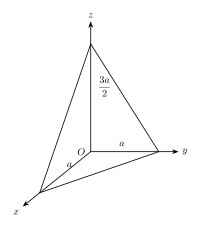
A homogeneous right triangular pyramid with the base side a and height \frac{3a}{2} is shown below. Obtain the moment of inertia tensor of the pyramid:
A body of mass m at rest splits into two masses m_1 and m_2 by an explosion. After the split the bodies move with a total kinetic energy T in opposite direction. Show that their relative speed is \sqrt{\frac{2Tm}{m_1m_2}}.
The radius of the Earth is 6.4 \times 10^{6}\ \mathrm{m}, its mean density is 5.5 \times 10^{3}\ \mathrm{kg/m^{3}} and the universal gravitational constant is 6.66 \times 10^{-1}\ \mathrm{Nm^{2}/kg^{2}}. Calculate the gravitational potential on the surface of the Earth.
A particle moving in a central force field describes the path r=ke^{\alpha\theta}, where k and \alpha are constants. If the mass of the particle is m, find the law of force.