Comment Done
๐Ÿ”/
โœ• Reset
20 questions visible on this page
Shortcuts: / filter, Esc reset

In a reference frame S, an event 1 occurs at the origin at t = 0 and another event 2 occurs at x = 4000\text{ m} and time t = 5 \times 10^{-6}\text{ s}. Find the time interval between the events as registered by clock in a frame S' moving with speed v = 0 \cdot 6 \, c relative to S along the common X-X' axis, the origin coinciding at t = t' = 0\,.

Full Thread
IFOS 202310 Marks

A particle of mass m moves under the action of a central force whose potential is V(r) = Kmr^4 (K > 0). Calculate the kinetic energy for which the orbit will be circle of radius R, about the origin.

Full Thread
IFOS 20238 Marks

A particle of mass m moves under the action of a central force whose potential is V(r) = Kmr^4 (K > 0). Calculate the kinetic energy for which the orbit will be circle of radius R, about the origin.

Full Thread
IFOS 20238 Marks

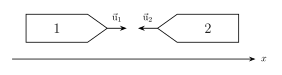
Two spaceships are approaching each other as depicted below.

Physics Diagram ifos-q-1-099-fig-1

Spaceship 1 is moving with a velocity \vec{\text{u}}_1 = 0\cdot 7\text{c }\hat{\text{x}}, while spaceship 2 is moving with a velocity \vec{\text{u}}_2 = -\,0\cdot 8\text{c }\hat{\text{x}} as measured by the stationary observer on Earth. Here, c is the velocity of light in vacuum and \hat{\text{x}} is the unit vector along the x-axis.

(i) What, according to Galilean addition of velocity, is the speed of spaceship 2 with respect to spaceship 1 (in terms of c) ?

(ii) What, according to relativistic addition of velocities, is the speed of spaceship 2 with respect to spaceship 1 (in terms of c) ?

(iii) Spaceship 1 emits a light signal towards spaceship 2. The observer on spaceship 2 measures the frequency of the light signal to be 10^{16}\text{ Hz}. What was the original frequency of the light signal ?
Full Thread
IFOS 20228 Marks

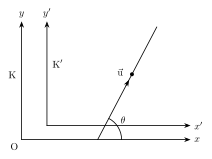
A particle of rest mass \text{m}_0 is moving in a stationary frame K with a velocity \vec{\text{u}} making an angle \theta with the x-axis as shown in the figure.

Physics Diagram ifos-q-1-100-fig-1

Find the corresponding angle \theta' made by the velocity vector of the particle with the \text{x}' axis in the frame \text{K}' that is moving with respect to K along the x-direction at a constant speed V.

Full Thread
IFOS 202215 Marks

Consider a particle of mass m moving in a potential field of the form \text{V}(\vec{\text{r}}) = \text{V}_0(\text{x}^2 + \text{y}^2), where \text{V}_0 is a constant. What are the conserved physical quantities for the particle ?

Full Thread
IFOS 20228 Marks

Consider the force-free motion of a symmetrical rigid body with z-axis as its axis of symmetry. Write down Euler's equations. Integrate them and obtain the solutions. On the basis of the obtained solutions show that the total angular velocity \vec{\omega} of such a rigid body is constant in magnitude and precesses about the z-axis with a constant frequency, say \Omega. Determine \Omega.

Full Thread
IFOS 202210 Marks

Consider the motion of a particle of mass m in central force field \text{f(r)} = -\,\text{k}/\text{r}^2, where k is a constant and r is the distance from the force centre to the particle. Show that for the given system the vector \vec{\text{A}} = \vec{\text{p}} \times \vec{\text{L}} - \text{mk} \, \frac{\vec{\text{r}}}{\text{r}} is conserved. Using this vector and the fact that \vec{\text{A}} \cdot \vec{\text{L}} = 0, derive the orbit equation for the particle.

Full Thread
IFOS 202215 Marks

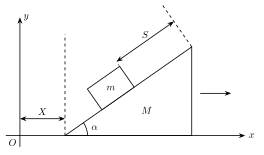
A small block of mass m slides without friction down a wedge-shaped block of mass M and opening angle \alpha as depicted below.

Physics Diagram ifos-q-1-027-fig-1

The wedge-shaped block itself slides along the horizontal frictionless floor along the +\text{ve x-direction}. Find the horizontal acceleration \ddot{\text{X}} = \text{d}^2\text{X}/\text{dt}^2 of the wedge-shaped block by the Lagrangian method and using the displacements \text{X} and \text{S} of the blocks as generalized coordinates.

Full Thread
IFOS 202215 Marks

A rigid body is rotating under the influence of an external torque (N) acting on it. If T is the kinetic energy and \omega is the angular velocity, show that \dfrac{dT}{dt} = N \cdot \omega in the principal axes system.

Full Thread
IFOS 202115 Marks

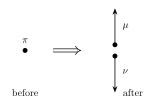
A pion at rest decays into a muon and a neutrino.

Physics Diagram ifos-q-1-098-fig-1

(i) Find the energy of the outgoing muon in terms of the two masses m_\pi and m_\mu (assuming m_\nu = 0). (ii) Find the velocity of muon.

Full Thread
IFOS 202113 Marks

(i) Define the angular velocity \omega of a rigid body rotating about some axis.

(ii) Then derive the relation \vec{v} = \vec{\omega} \times \vec{r} for the velocity of a point in the body with position vector \vec{r} relative to an origin on the axis. Draw a diagram explaining all the vectors.

Full Thread
IFOS 20218 Marks

Obtain the Lorentz transformations for the components of momentum-energy four vector.

Full Thread
IFOS 20218 Marks

During take-off, an aircraft accelerates horizontally in a straight line at a rate A. A small bob of mass m is suspended on a string attached to the roof of the cabin, and a hydrogen balloon (total mass m) is tethered to the floor by a string. For each, determine the tension in the string and the equilibrium angle \theta between string and vertical. Draw a neat diagram to explain your answer.

Full Thread
IFOS 202110 Marks

A comet of mass m moves towards the Sun with initial velocity v_0. The mass of the sun is M and its radius is R. Find the total cross-section \sigma for striking the Sun. Take the Sun to be at rest and ignore all other bodies.

Full Thread
IFOS 20218 Marks

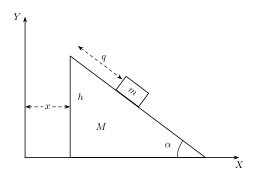
A block of mass m is sliding on a wedge of mass M as shown in the figure below. The wedge can slide on the horizontal table. Find the equation of motion.

Physics Diagram ifos-q-1-025-fig-1
Full Thread
IFOS 202115 Marks

On a space-time diagram after the Lorentz transformation with given v we get new tilted axis ct' and x'. For a point on the ct' axis which is at the (geometrical) distance \delta on the diagram measured from the origin, find the values of t' and t.

Full Thread
IFOS 202110 Marks

(i) Explain Coriolis force. Compare the qualitative effects of the Coriolis forces in the two geographical hemispheres of the Earth for rivers flowing east. (ii) With schematic, explain Foucault's pendulum.

Full Thread
IFOS 20207+8=15 Marks

Explain the rotation of a free rigid body and show that a rigid body rotating in any manner about a fixed point has two constants of motion, L^2 and T. Here \vec{L} is angular momentum and T is kinetic energy.

Full Thread
IFOS 20208 Marks

A rocket of mass m_1 + m_2 is launched with a velocity whose horizontal and vertical components are u_x and u_y. At the highest point in its path, the rocket explodes into two parts of masses m_1 and m_2 that separate in a horizontal direction in the original plane of motion. Show that the fragments strike the ground at a distance apart given by D = \frac{u_y}{g} \sqrt{\frac{2(m_1 + m_2)K}{m_1 m_2}} where K is the kinetic energy produced by the explosion. (Neglect air resistance, the mass of explosive, any spinning motion of the fragments and assume that g is constant)

Full Thread
IFOS 202010 Marks

Document & Diagram Scanner

Clean whiteboard & high-contrast scan with automatic image enhancement

Filter:
-- ร— -- pxCompressed: -- KB--% saved