Comment Done
๐Ÿ”/
โœ• Reset
20 questions visible on this page
Shortcuts: / filter, Esc reset

Suppose the position of a particle of mass m on the xy-plane is \bar{r} = (x, y, z) = (r \cos\phi, r \sin\phi, 0) Here r and \phi are functions of time t. Find l_z, the z-component of \vec{l}, where \vec{l} is the angular momentum of the particle. Further, show that the areal velocity is equal to the angular momentum divided by 2m. Is areal velocity constant?

Full Thread
IFOS 20208 Marks

A rocket of mass m_1 + m_2 is launched with a velocity whose horizontal and vertical components are u_x and u_y. At the highest point in its path, the rocket explodes into two parts of masses m_1 and m_2 that separate in a horizontal direction in the original plane of motion. Show that the fragments strike the ground at a distance apart given by D = \frac{u_y}{g} \sqrt{\frac{2(m_1 + m_2)K}{m_1 m_2}} where K is the kinetic energy produced by the explosion. (Neglect air resistance, the mass of explosive, any spinning motion of the fragments and assume that g is constant)

Full Thread
IFOS 202010 Marks

(i) Explain Coriolis force. Compare the qualitative effects of the Coriolis forces in the two geographical hemispheres of the Earth for rivers flowing east. (ii) With schematic, explain Foucault's pendulum.

Full Thread
IFOS 20207+8=15 Marks

The moment of inertia of the CO molecule is 1\cdot 46 \times 10^{-46}\text{ kg-m}^2. Calculate the energy (in eV), and the angular velocity in the lowest rotational energy level of the CO molecule.

Full Thread
IFOS 202010 Marks

Explain the rotation of a free rigid body and show that a rigid body rotating in any manner about a fixed point has two constants of motion, L^2 and T. Here \vec{L} is angular momentum and T is kinetic energy.

Full Thread
IFOS 20208 Marks

Derive Euler-Lagrange equations of motion from Hamilton's principle for any bilateral holonomic system having no non-potential forces and n degree of freedom. Can it be applied to non-holonomic systems?

Full Thread
IFOS 202015 Marks

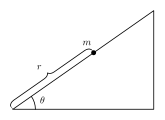
A particle of mass m rests on a smooth plane. The plane is then raised to an inclination angle \theta at a constant rate \alpha (\theta = 0 at t = 0), causing the particle to move down the plane, as shown in the figure below.

Physics Diagram ifos-q-1-019-fig-1

Write down the Lagrangian and determine the equations of motion. Solve the resulting equation for "r" to obtain the expression for r(t).

Full Thread
IFOS 201920 Marks

A particle moves in an elliptical orbit in an inverse-square-law central force field. If the ratio of the maximum angular velocity to the minimum angular velocity of the particle in the orbit is n, then show that the eccentricity of the orbit is \varepsilon = \frac{\sqrt{n} - 1}{\sqrt{n} + 1}.

Full Thread
IFOS 201910 Marks

How fast and in what direction must galaxy A be moving if an absorption line found at wavelength 550\text{ nm} (green) for a stationary galaxy is shifted to 450\text{ nm} for galaxy A and how fast and in what direction is galaxy B moving if the same line is shifted to 700\text{ nm} for it ?

Full Thread
IFOS 20198 Marks

Consider a light beam passing through a horizontal column of water moving with a velocity 'v'. Determine the speed u of the light measured in the lab frame when the beam travels in the same direction as the flow of the water. (Speed of water = v (lab frame), and refractive index = n)

Full Thread
IFOS 201915 Marks

A three-particle system consists of masses \text{m}_i,\ i = 1, 2, 3 and their respective coordinates (\text{x}_i, \text{y}_i, \text{z}_i) : m_1 = 3m,\ (x_1, y_1, z_1) = (a, 0, a), m_2 = 4m,\ (x_2, y_2, z_2) = (a, a, -a), m_3 = 2m,\ (x_3, y_3, z_3) = (-a, a, 0), where m and a are positive constants. Calculate the inertia tensor of the system.

Full Thread
IFOS 201910 Marks

A mouse of mass m jumps on the outside edge of a freely turning ceiling fan of rotational inertia I and radius R. By what ratio does the angular velocity change ?

Full Thread
IFOS 20198 Marks

Show that the wave equation for the propagation of electromagnetic scalar potential \phi(x, y, z, t) \left[\nabla^2 - \frac{1}{c^2} \frac{\partial^2}{\partial t^2}\right] \phi(x, y, z, t) = 0 remains invariant under Lorentz transformation.

Full Thread
IFOS 201810 Marks

A particle moving in a central force field located at r=0, describes a spiral, r=e^{-\theta}. Find the force law.

Full Thread
IFOS 20188 Marks

A particle of mass m is constrained to move on a plane curve xy=c with c>0, under gravity, where y-axis is vertical. Construct the Lagrangian of the system and obtain the Euler-Lagrange equation of motion.

Full Thread
IFOS 201810 Marks

Consider a homogeneous cube of total mass M and side a. Taking the origin at one corner of the cube and axes along the edges of the cube, construct the moment of inertia tensor. Calculate principal moment of inertia.

Full Thread
IFOS 201815 Marks

Calculate the first relativistic correction to the kinetic energy of a particle with rest mass m_0 and speed v.

Full Thread
IFOS 20188 Marks

In special theory of relativity, the Hamiltonian of a free particle with rest mass m_0 is given by \sqrt{p^2 c^2 + m_0^2 c^4}. Obtain the Lagrangian of the system using Legendre transformation.

Full Thread
IFOS 201810 Marks

(i) State and prove Hamilton's principle and use it to prove that the shortest distance between two points in space is a straight line joining them. (ii) Use Hamiltonian mechanics to find the differential equation for planetary motion, moving under force f(r) = -\frac{k}{r^2} and prove that the areal velocity is constant.

Full Thread
IFOS 20178+7=15 Marks

Discuss the mechanics of a system of point particles with special emphasis on the conservation theorems. How can we extend the results to a system with continuous mass distribution ?

Full Thread
IFOS 201710 Marks

Document & Diagram Scanner

Clean whiteboard & high-contrast scan with automatic image enhancement

Filter:
-- ร— -- pxCompressed: -- KB--% saved