Prove that as a result of an elastic collision of two particles under non-relativistic regime with equal masses, the scattering angle will be 90^\circ. Illustrate your answer with a vector diagram.
5 Marks
Prove that as a result of an elastic collision of two particles under non-relativistic regime with equal masses, the scattering angle will be 90^\circ. Illustrate your answer with a vector diagram.
Calculate the horizontal component of the Coriolis force acting on a body of mass 0.1\ \mathrm{kg} moving northward with a horizontal velocity of 100\ \mathrm{ms^{-1}} at 30^{\circ}\mathrm{N} latitude on the Earth.
Suppose that an S'-frame is rotating with respect to a fixed frame having the same origin. Assume that the angular velocity \vec{\omega} of the S'-frame is given by \vec{\omega}=2t\hat{\imath}-t^{2}\hat{\jmath}+(2t+4)\hat{k} where t is time and the position vector \vec{r} of a typical particle at time t as assumed in S'-frame is given by \vec{r}=(t^{2}+1)\hat{\imath}-6t\hat{\jmath}+4t^{3}\hat{k}. Calculate the Coriolis acceleration at t=1 second.
Show that the operator \left(\nabla^2-\frac{1}{c^2}\frac{\partial^2}{\partial t^2}\right) is invariant under Lorentz transformations.
Show that the kinetic energy and angular momentum of torque free motion of a rigid body is constant.
If the forces acting on a particle are conservative, show that the total energy of the particle which is the sum of the kinetic and potential energies is conserved.
Show that a particle of rest mass m_0, total energy E and linear momentum \vec{p} satisfies the relation E^2=c^2p^2+m_0^2c^4 where c is the velocity of light in free space.
A particle of rest mass M=4\times10^{-27}\ \mathrm{kg}, disintegrates into two particles of rest masses M_1=3\times10^{-27}\ \mathrm{kg} and M_2=1\times10^{-27}\ \mathrm{kg}. Show that the energies E_1 and E_2 of these two parts after disintegration satisfy the condition E_1=3E_2 while moving in opposite directions with equal linear momenta. Give necessary mathematical derivation.
Derive the relativistic length contraction using Lorentz transformation.
A particle describes a circular orbit under the influence of an attractive central force directed towards a point on the circle. Show that the force varies as the inverse fifth power of distance.
A projectile of mass M explodes, while in flight, into three fragments. One fragment of mass m_1=M/2 travels in the original direction of the projectile. Another fragment of mass m_2=M/6 travels in the opposite direction and the third fragment of mass m_3=M/3 comes to rest. The energy E, released in the explosion, is 5 times the kinetic energy of the projectile at explosion. What are the velocities of the fragments?
A rigid body is spinning with an angular velocity of 4\ \mathrm{rad\,s^{-1}} about an axis parallel to the direction (4\hat{\jmath}-3\hat{k}) passing through the point A with \overrightarrow{OA}=2\hat{\imath}+3\hat{\jmath}-\hat{k}, where O is the origin of the coordinate system. Find the magnitude and direction of the linear velocity of the body at point P with \overrightarrow{OP}=4\hat{\imath}-2\hat{\jmath}+\hat{k}.
Consider a uniform half-sphere of radius R and mass M. The half-sphere is supported by a frictionless horizontal plane as shown in the figure. The half-sphere lies in the region z<0.
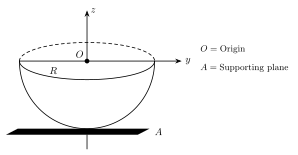
Find the centre of mass of the half-sphere.
Define a conservative field. Determine if the field given below is conservative in nature: \vec{E}=c\left[y^2\hat{i}+(2xy+z^2)\hat{j}+2yz\hat{k}\right]\,\mathrm{V/m} where c is a constant.
Calculate the moment of inertia of a solid cone of mass M, height h, vertical half-angle \alpha and radius of its base R, about an axis passing through its vertex and parallel to its base.
Two identical relativistic particles of rest mass m and kinetic energy T collide head-on. What is the relative kinetic energy, i.e., the kinetic energy T' of one in the rest frame of the other?
A particle is moving in a central force field on an orbit given by r = ke^{\alpha\theta}, where k and \alpha are positive constants, r is the radial distance and \theta is the polar angle.
(i) Find the force law for the central force field.
(ii) Find \theta(t).
(iii) Find the total energy.
On the basis of three principal moments of inertia I_A, I_B and I_C each about X, Y and Z axes respectively, how can you classify molecules?
A spaceship measures 50 m in length on ground and it measured a length of 49.7 m in space as observed from the ground. Find out the speed of the spaceship.
With an appropriate diagram, show that in the Rutherford scattering, the orbit of the particle is a hyperbola. Obtain an expression for impact parameter.