A uniform rod of length L and mass m stands vertically upright on a rough floor and then tips over. What is the rod's angular velocity when it hits the floor?
10 Marks
A uniform rod of length L and mass m stands vertically upright on a rough floor and then tips over. What is the rod's angular velocity when it hits the floor?
Consider a particle of mass m in two dimensions experiencing a central force \vec{F} = -k\vec{r}, where k is a positive constant and \vec{r} is the radius vector of the particle relative to the force center.
(i) What is the angular momentum \vec{J} of the particle relative to the force center? Show that \vec{J} is conserved.
(ii) Write down the system of equations of motion in two dimensions in polar coordinates. Reduce this system to a one-equation problem and find the equation for the effective potential energy U_{\text{eff}}.
A pion at rest decays into a muon and a neutrino (see the figure) :
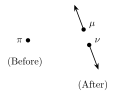
Find the velocity of the muon.
A cardiologist reports to her patient that the radius of the left anterior descending artery of the heart has narrowed by 10\%. What percent increase in the blood pressure is required to maintain the normal blood flow through this artery? Assume that the viscosity of the blood and the length of the artery remain unchanged.
The energy of a photon is expressed as E = h\nu, where h is the Planck's constant and \nu is the frequency of the photon. The momentum of the photon is \frac{h\nu}{c}, where c is the speed of light. Show that if a photon scatters from a free electron (of mass m_e), the scattered photon has energy E' = E \left[ 1 + \frac{E}{m_e c^2} (1 - \cos\theta) \right]^{-1} where \theta is the angle through which the photon scatters. Also, show that the electron acquires a kinetic energy T = \frac{E^2}{m_e c^2} \left[ \frac{1 - \cos\theta}{1 + \frac{E}{m_e c^2}(1 - \cos\theta)} \right]
Consider a symmetric top of mass M, with its tip held fixed, rotating in a gravitational field. Assuming that the origins of the fixed and body coordinate systems coincide, determine the Lagrangian of the top. Are there any angular momenta which are conserved? If yes, find their expressions.
Derive the expression for the gravitational self-energy of a uniform solid sphere of mass M and radius R.
A body moves about a point ‘O’ under no force, the principal moments of inertia at ‘O’ being 3A, 5A and 6A. The components of the initial angular velocity about the principal axes are \omega_1 = n, \omega_2 = 0 and \omega_3 = n. Find the components \omega_1, \omega_2 and \omega_3 for large values of time t.
A particle of rest mass 1\text{ kg} and velocity of magnitude 0\cdot 9c collides with a particle of mass 2\text{ kg} at rest. After collision the two particles coalesce and form a single particle of mass M and velocity V. Determine M and V.
A cube of mass M and side ‘a’ is rotating with angular velocity \omega around one of its edges, which is, say, along the x-axis. Obtain the expressions for its angular momentum and kinetic energy. (Given that the I_{XX} = \frac{2}{3} Ma^2, I_{YX} = -\frac{1}{4} Ma^2 and I_{ZX} = -\frac{1}{4} Ma^2)
Consider a large stationary cylinder of inner radius R. A smaller solid cylinder of radius r rolls without slipping inside the larger cylinder. Determine the equation of motion of the smaller cylinder.
A solid shaft of mass M, length l and radius r is to be replaced by a lighter hollow shaft of the same length l and having the same ratings of \tau/\theta, where \tau is the couple and \theta is the angle of twist. Estimate the percentage reduction in mass of the hollow shaft if the outer radius of the shaft is twice the inner radius. Assume the material of the new shaft is same as that of the replaced shaft.
Explain the Poiseuille's equation for the rate of flow of a liquid through a capillary tube. From this, show that if two capillary tubes of radii r_1 and r_2 having lengths l_1 and l_2, respectively, are connected in series, the rate of flow of the liquid is given by Q = \frac{\pi P}{8 \eta} \left( \frac{l_1}{r_1^4} + \frac{l_2}{r_2^4} \right)^{-1} where P is the pressure across the arrangement and \eta is the coefficient of viscosity of the liquid.
Show that the angular momentum of a rigid body consisting of n particles of masses m_i, i = 1, 2, 3, \dots, n, rotating with an instantaneous angular velocity \mathbf{\omega} about an axis passing through the origin O of the coordinate system OXYZ is given by \mathbf{L} = \mathbf{I} \cdot \mathbf{\omega}, where \mathbf{I} is known as the inertia tensor.
State and explain the Hooke's law of elasticity. Briefly discuss the features of stress-strain diagram for the behaviour of a wire undergoing increasing stress.
Show that the escape velocity V_e on the surface of the Earth is given by V_e = \sqrt{2gR}, where g = 9.8\text{ m/s}^2 and R is the radius of the Earth.
A particle of mass m\text{ kg} having an initial velocity V_0 is subjected to a retarding force proportional to its instantaneous velocity. Obtain the expression for the velocity and position of the particle as a function of time.
Briefly discuss the Kepler's laws of planetary motion.
Two satellites A and B of same mass are orbiting the Earth at altitudes R and 5R, respectively, where R is the radius of the Earth. Assuming their orbits to be circular, calculate the ratios of their kinetic and potential energies.
Show that the kinetic energy of a system of n particles is given by T = \frac{1}{2} M V_{\text{cm}}^2 + \frac{1}{2} \sum_{i=1}^n m_i {V'_i}^2 where M is the total mass, V_{\text{cm}} is the velocity of the centre of mass, V'_i is the velocity of the particles about the centre of mass and m_i is the mass of the i\text{th} particle.