What is de Broglie concept of matter wave? Evaluate de Broglie wavelength of Helium that is accelerated through 300\mathrm{V}. (Given mass of proton = mass of neutron = 1.67\times10^{-27}\,kg)
10 Marks
What is de Broglie concept of matter wave? Evaluate de Broglie wavelength of Helium that is accelerated through 300\mathrm{V}. (Given mass of proton = mass of neutron = 1.67\times10^{-27}\,kg)
Obtain the normalized eigenvectors of \sigma_x and \sigma_y matrices.
Find the minimum magnetic field needed for the Zeeman effect to be observed in a spectral line of 400\,\mathrm{nm} wavelength when a spectrometer whose resolution is 0.010\,\mathrm{nm} is used. Write the answer in the nearest high integer.
Calculate the Larmor precessional frequency for a magnetic induction field of 0.5\,\mathrm{T}. Hence calculate the splitting in wave numbers of a spectral line due to normal Zeeman effect for the same field.
Describe normal and anomalous Zeeman effect. Explain how it lifts the degeneracy in hydrogen atom.
Normalised wave function of hydrogen atom for 1s state is \psi_{100}=\frac{1}{\sqrt{\pi a_0^3}}e^{-r/a_0},\text{ where }a_0=\frac{\hbar^2}{me^2} being the Bohr radius. Calculate the expectation value of potential energy in this state.
A particle of rest mass m_0 has a kinetic energy K, show that its de Broglie wavelength is given by \lambda=\frac{hc}{\sqrt{\left[K\left(K+2m_0c^2\right)\right]}}. Hence calculate the wavelength of an electron of kinetic energy 2\mathrm{MeV}. What will be the value of \lambda if K << m_0c^2?
A beam of 12\,\mathrm{eV} electron is incident on a potential barrier of height 25\,\mathrm{eV} and width 0.05\,\mathrm{nm}. Calculate the transmission coefficient.
Calculate the probability of finding a simple harmonic oscillator within the classical limits if the oscillator is in its normal state. Also show that if the oscillator is in its normal state, then the probability of finding the particle outside the classical limits is approximately 16\%.
Using Pauli spin matrices prove that,
(i) \sigma_x\sigma_y+\sigma_y\sigma_x=0;\ \sigma_y\sigma_z+\sigma_z\sigma_y=0;\ \sigma_x\sigma_z+\sigma_z\sigma_x=0
(ii) \sigma_+\sigma_-=2(1+\sigma_z)
(iii) \sigma_\alpha+\sigma_\beta=i\sigma_\gamma where \alpha\ne\beta\ne\gamma
Find the uncertainty in the momentum of a particle when its position is determined within 0.02 cm. Find also the uncertainty in the velocity of an electron and \alpha-particle respectively when they are located within 15 \times 10^{-8}\,cm.
A particle is moving in a one-dimensional box of width 50\,\mathring{\mathrm{A}} and infinite height. Calculate the probability of finding the particle within an interval of 15\,\mathring{\mathrm{A}} at the centres of the box when it is in its state of least energy.
Write the wave functions for a particle on both sides of a step potential, for E>V_0: V(x)=\begin{cases} V_0, & x>0\\ 0, & x<0 \end{cases}
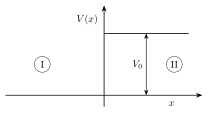
Interpret the results physically.
A particle is described by the wave function \Psi(x)=\left(\frac{\pi}{2}\right)^{-1/4}e^{-ax^2/2}. Calculate \Delta x and \Delta p for the particle, and verify the uncertainty relation \Delta x\Delta p=\frac{\hbar}{2}.
Find the probability current density for the wave function \Psi(x,t)=\left[Ae^{ipx/\hbar}+Be^{-ipx/\hbar}\right]e^{-ip^2t/2m\hbar} Interpret the result physically.
What is Zeeman effect? Explain Zeeman effect on the basis of classical electron theory.
Prove that Bohr hydrogen atom approaches classical conditions, when n becomes very large and small quantum jumps are involved.
Consider a Hermitian operator A with property A^3=1. Show that A=1.
A blue lamp emits light of mean wavelength of 4500\ \mathring{\mathrm{A}}. The rating of the lamp is 150 W and its 8% of the energy appears as light. How many photons are emitted per second by the lamp?
Using the uncertainty principle \Delta x\Delta p \geq \hbar/2, estimate the ground state energy of a harmonic oscillator.