Consider a particle of mass m in an infinite one dimensional potential well of width a. The particle is found in the state given by \psi (x) = c \left[ \sin \frac{\pi x}{a} + \frac{1}{2} \sin \frac{2 \pi x}{a} \right] (i) Calculate c. (ii) If a measurement of energy is made, what are the possible results and what are the probabilities for each one of them ?
(i) The ground state wavefunction of a linear simple harmonic oscillator is \psi = A \exp \left( - \frac{\alpha^2 x^2}{2} \right) Calculate the constant A and the average values of x^2 and x. Given that \int_0^\infty e^{-x^2} = \frac{\pi^{1/2}}{2} (ii) How can the pure rotation spectrum of \text{H}_2 molecule be observed ? If the bond length of \text{H}_2 molecule is 0 \cdot 07417 \text{ nm}, what would be the spacing of lines in its spectrum ?
Set up the time-independent Schrodinger equation for an electron moving in Coulomb field, V(r) = \frac{Ze^2}{4 \pi \varepsilon_0 r}, in polar coordinates. Solve the radial equation to get the energy eigen values.
(i) Write the commutation relations for the position variable x and the momentum components p_x, p_y and p_z. Explain the physical significance of these relations. (ii) Calculate the de Broglie wavelength of an electron moving with a kinetic energy of 1 MeV.
Discuss WKB approximation and apply the same to determine the transition probability for leakage through a potential barrier.
Set up the time-independent Schrodinger equation for an electron moving in Coulomb field, V(r) = \frac{Ze^2}{4\pi\varepsilon_0 r} in polar coordinates. Solve the radial equation to get the energy eigen values.
A hydrogen atom is in the following state : \Psi_{nlm} (r, 0) = (\sqrt{1/14}) [2\psi_{100}(r) - 3\psi_{200}(r) + \psi_{322}(r)] (i) What is the probability of finding the system in the state (200) ? (ii) What are \langle H \rangle and \langle L_z \rangle ?
(i) Show that the radial probability density of the ground state of the hydrogen atom has a maximum at r = a. The ground state wave function of the hydrogen atom is given by \psi (r) = \frac{1}{\sqrt{\pi a^{3/2}}} e^{-r/a} where a is the Bohr radius. (ii) Calculate the Larmor frequency of a spin 1/2 particle in a magnetic field B.
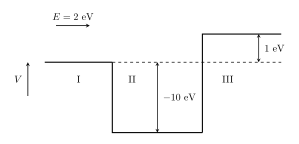
(i) Explain what do you understand by Heisenberg uncertainty principle. Using this principle, determine the energy of the ground state of a one dimensional simple harmonic oscillator. (ii) An electron having an energy 2 eV is travelling in the region where V(x) varies as shown below:
Calculate the de Broglie wavelength of the electron in regions I, II and III.
Obtain an expression from which the energy eigen values can be determined.
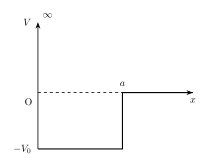
A particle of mass m, with energy E such that -V_0 < E < 0, is trapped in a potential wall as shown below :
Write time independent Schrodinger equation in regions (i) 0 < x < a and (ii) x > a.
Show that for at least one bound state to exist. a^2 V_0 \ge \frac{h^2 \pi^2}{8m}
Number at non-interacting electrons are confined in a cube of volume L^3. Obtain an expression for the Fermi energy.
= 0$. What is the significance of this commutation relation ? (ii) Show that the Pauli Matrices anti-commute.
Derive an expression for the electrical conductivity of metals on the basis of free electron theory of metals.
(i) The wave function of a particle is . \psi(x) = A \exp \left( -\frac{x^2}{a^2} + i k_0 x \right) Find the expectation values of position (x) and momentum (p) for the particle. (ii) A 200 eV increase in the energy of an electron changes its De Broglie wavelength by a factor of two. Calculate the initial De Broglie wavelength of the electron.
Distinguish between a classical and a quantum mechanical harmonic oscillator. Explain the existence of zero point energy.
Solve the one dimensional Schrodinger wave equation with potential: V(x) = \begin{cases} 0 & \text{for } x < -a \\ V_0 & \text{for } -a < x < a \\ 0 & \text{for } x > 0 \end{cases}
A particle is in a quantum system with a parabolic potential well. (i) Using appropriate method find the ground state energy. (ii) Obtain an expression for the ground state.
(i) Write down the matrix representation of the energy operator of a linear oscillator. (ii) A linear oscillator is prepared in the state given by \psi(x) = 1/\sqrt{5} \{\hat{\psi}_0(x) + \sqrt{2} \hat{\psi}_1(x) + \sqrt{2} \hat{\psi}_2(x)\} Evaluate the energy of the oscillator in this state.