Write Bose-Einstein distribution function explaining every symbol. Derive Einstein's result on specific heat of solids explaining the assumptions made in the model. Discuss the low and high temperature limits of the predicted specific heat. In which limit, the Einstein formula fails to explain the experimental data?
Show that the probability of occupation for an electron state at the Fermi energy is equal to 0\cdot 5 for all finite temperatures.
Derive the mathematical expression for the total energy of a degenerate Fermi gas at a temperature T and calculate the specific heat of the Fermi gas at this temperature.
Prove the thermodynamic relation : \left( \frac{\partial S}{\partial V} \right)_T = \left( \frac{\partial P}{\partial T} \right)_V and hence show that \frac{\mathrm{d}P}{\mathrm{d}T} = \frac{L}{T (V_2 - V_1)} ; all the terms have their usual meanings.
State Maxwell's distribution law of molecular speeds. Draw and explain a curve between n(c) and c in a gas at a given temperature T, where n(c) dc is the number of molecules having speed between c and c + dc. Discuss the effect of T and mass m of the molecule on the nature of the curve.
Describe neutron star on the basis of Fermi-Dirac statistics and obtain the condition of critical mass for a neutron star.
Write down the expression for the Bose-Einstein distribution function and explain the meaning of the symbols used.
A system of non-interacting fermions enclosed in a volume, V, is at T = 0^\circ\text{K}. Find an expression for the internal energy, U, of the system.
Derive the expression for the specific heat of a solid based on Einstein's theory. Obtain the limiting form of the specific heat at very low temperature.
The mean speed of the molecules of an ideal monatomic gas when it contracts (or expands) adiabatically depends on the pressure according to the law v = K p^n, where K is a constant. Find n.
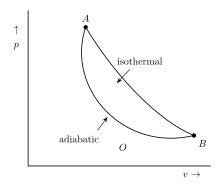
A quasistatic isothermal and quasistatic adiabatic intersect in a p-v diagram at more than one point as shown in diagram. Does it imply violation of 2nd law of thermodynamics ? Give reasons for your answer.
Plot the Fermi distribution function versus energy at temperatures T = 0 and T > 0. Explain the nature of the former curve on the basis of the Pauli principle.
Derive an expression for the total number of particles N in an ideal Bose gas at any temperature T. Hence, obtain the relation N_0 = N \left[ 1 - \left( \frac{T}{T_0} \right)^{\frac{3}{2}} \right] for the number of particles N_0 in the ground state at T < T_0, the Bose-Einstein condensation temperature, and draw N_0 versus T curve.
Discuss the consequence following from Joule's free expansion experiments in the context of the internal energy of an ideal gas.
Start from the equation T dS = C_p dT - T \left( \frac{\partial V}{\partial T} \right)_P dP and get the relation \left( \frac{\partial C_p}{\partial P} \right)_T = -T \left( \frac{\partial^2 V}{\partial T^2} \right)_P Hence, show that the third law of thermodynamics requires for the coefficient of thermal expansion of any substance to vanish at T = 0.
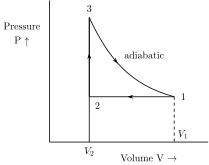
The figure below represents an imaginary ideal gas cycle. Assuming constant heat capacities, show that the thermal efficiency is : \eta = 1 - Y \frac{(V_1/V_2) - 1}{(P_3/P_2) - 1}
Show that the elemental quantity of heat dQ is not a total differential.
For a degenerate Fermi-Dirac gas, the concentration of nucleons in nuclear matter is N = 1.1 \times 10^{38}\text{ cm}^{-3}. Calculate the Fermi energy and Fermi temperature.
Derive an expression for the Fermi energy for a free electron gas at T = 0. Compute the Fermi temperature of Cu assuming the density 9\text{ gms/cm}^3 and one conduction electron per atom.
What is transport phenomenon ? Obtain the expression for the coefficient of viscosity. Discuss its temperature dependence.