Calculate the pressure at which water will boil at 150\text{ }^\circ\text{C}, given that the change in specific volume when 1\text{ gram} of water is converted into steam is 1676\text{ cm}^3. Given, latent heat of vaporization for steam = 540\text{ cal per gram}, J = 4\cdot 2 \times 10^7\text{ ergs/cal} and one atmospheric pressure = 10^6\text{ dynes/cm}^2.
A gas has only two particles a and b. Show with the help of diagrams how these two particles can be arranged in three energy states 1, 2, 3 using (i) Maxwell--Boltzmann, (ii) Fermi--Dirac and (iii) Bose--Einstein statistics.
The average kinetic energy of hydrogen atoms in a certain stellar atmosphere, assumed to be in thermal equilibrium, is 1\cdot 2\text{ eV}. Calculate the ratio of the number of atoms in the second excited state (n = 3) to the number in the ground state.
Two solids A and B have Debye temperatures 200\text{ K} and 300\text{ K} respectively. At T = 20\text{ K}, compare their specific heats.
Why does the specific heat of solids depend on material at low temperatures but become independent of material at high temperatures?
What are the limitations of the first law of thermodynamics? One mole of a gas, assumed to be perfect, at 0\text{ }^\circ\text{C} is heated at constant pressure till its volume is twice its initial value. Calculate the amount of heat absorbed. Given, C_v = 20\cdot 9\text{ J}\cdot\text{mol}^{-1}\cdot\text{K}^{-1} and R = 8\cdot 3\text{ J}\cdot\text{mol}^{-1}\cdot\text{K}^{-1}.
A reversible heat engine operates with three reservoirs at 300\text{ K}, 400\text{ K} and 1200\text{ K}. It absorbs 1200\text{ kJ} energy as heat from the reservoir at 1200\text{ K} and delivers 400\text{ kJ} work. Determine the heat interactions with the other two reservoirs.
Consider a mixture of N_A molecules of a monatomic gas A and N_B molecules of a monatomic gas B. For this mixture, obtain the Helmholtz free energy and pressure. (The particle partition function for a monatomic gas is q = \left(\frac{2\pi m k T}{h^2}\right)^{\frac{3}{2}} V).
Explain why, at equilibrium, the chemical potential of a component must be the same in all coexisting phases. Derive the equilibrium condition for a binary liquid-vapour system in terms of chemical potential.
Discuss briefly the considerations which led Van der Waals to modify the gas equation. What are the critical constants of a gas ? Calculate the values of these constants in terms of the constants of the Van der Waals equation.
A ternary system consists of three components (A, B and C) in equilibrium with two phases. Determine the number of degrees of freedom using the Gibb's phase rule and discuss the effect of pressure and temperature variations on the phase equilibrium.
Prove that the work done by a perfect gas during a quasi-static adiabatic expansion is given by W = \frac{P_i V_i}{\gamma - 1} \left[ 1 - \left( \frac{P_f}{P_i} \right)^{\frac{\gamma - 1}{\gamma}} \right] where \gamma is the ratio of specific heats.
The specific heat of a solid at low temperatures is given by the relation C_V = AT^3, where A is a constant and T is the absolute temperature. How much heat will be required to raise the temperature of m\text{ gm} of the solid from 300\text{ K} to 500\text{ K}?
Explain the T-s diagram for the reversible Carnot cycle and hence obtain the expression for the efficiency of the Carnot engine.
Define internal energy U, Helmholtz's function F, enthalpy H, Gibbs' potential G and hence obtain the four Maxwell's thermodynamic relations.
Calculate the Fermi energy in electron-volt for sodium assuming that it has one free electron per atom. The density of sodium = 0.97\text{ gm/cc} and the atomic weight of sodium is 23.
What do you understand by macrostates and microstates? Briefly explain.
(i) Define Joule-Kelvin coefficient. Write it in its mathematical form. (ii) Determine the Joule-Kelvin coefficient for a van der Waals gas. Hence, obtain an expression for temperature of inversion. Discuss the conditions under which heating or cooling is produced.
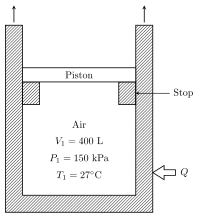
A piston-cylinder device initially contains air at 150\text{ kPa} and 27^\circ\text{C}. At this state, the piston is resting on a pair of stops, as shown in the figure, and the enclosed volume is 400\text{ L}. The mass of the piston is such that a 350\text{ kPa} pressure is required to move it. The air is now heated until the volume is doubled. Determine : (i) the final temperature, (ii) the work done by the air, and (iii) the total heat transferred to air. Given : U_{300\text{ K}} = 214\text{ kJ/kg} and U_{\text{final}} = 1113\text{ kJ/kg} Gas constant of air, R = 0\cdot287\text{ kPa.m}^3/\text{kg.K}
Use the Maxwell-Boltzmann distribution to find the number of oxygen molecules whose velocities lie between 195\text{ m/s} and 205\text{ m/s} at 0^\circ\text{C}. The given mass of oxygen gas is 0\cdot1\text{ kg}. (Assume mass of proton to be 1\cdot66 \times 10^{-27}\text{ kg})