A muon (\mu meson) is for med high up in the atmosphere and travels towards the earth with a speed of 0.992\text{ c}. It decays af ter travelling a distance of 6.0\text{ km}. In what time does the muon decay as measured (i) by us and (ii) in its own frame of reference? What is the distance covered the muon in its own frame of reference?
Write a note on Predictions of general theory of relativity and their experimental verification.
The mean distance of the Earth from the Sun is 1.496 \times 10^{11}\text{ m}, while that of Saturn is 1.427 \times 10^{12}\text{ m}. Find the time taken by Saturn to complete one revolution round the Sun.
Write a note on Coriolis force and its manifestations.
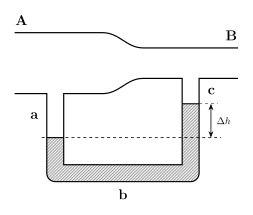
Air is blown through a pipe AB, at a rate of 15\text{ litres per minute}. The area of cross-section at A is 2\text{ cm}^2 whereas at B it is 0.2\text{ cm}^2. A tube abc, containing some water, is connected as shown. Find the difference in height, \Delta h, between the levels of water in the tube abc.
For an isotropic solid define Young's modulus of elasticity Y, coefficient of rigidity \eta and Poisson's ratio \alpha. Establish the relation. \sigma = \frac{Y - 2\eta}{2\eta}
Find the expression for the rise of a liquid between two parallel plates separated by a distance t and dipped vertically in the liquid.
Explain, on the basis of bond structure, the behaviour of insulators and conductors. Describe the effect of adding donor or acceptor impurities on conduction in a semi-conductor. Explain the action of a p-n junction as a rectifier. \begin{aligned} \text{Mass of electron} &= 9.1 \times 10^{-31}\text{ kg} \\\\ 1\text{ a.m.u} &= 931\text{ MeV} \\\\ \text{Avogadro's numbers} &= 6.1 \times 10^{23}\text{ (gm-mole)}^{-1} \\\\ \varepsilon_0 &= 1/36\pi \times 10^{-9}\text{ f/m} \\\\ h &= 6.6 \times 10^{-27}\text{ erg sec} \\\\ c &= 3.0 \times 10^{10}\text{ cm/sec} \\\\ 1\text{ eV} &= 1.6 \times 10^{-19}\text{ erg} \\\\ &= 1.6 \times 10^{-19}\text{ joule} \end{aligned}
Give an account of the basic principles of radio transmission and reception. Detailed circuits are not necessary but schematic diagrams indicating functions of various units may be shown.
Draw a complete circuit for common emitter (small signal) amplifier for low frequencies and explain briefly its working.
A triode has a transconductance (g_m) of 1,600\text{ micromhos}. The following table gives two sets of the plate voltage (E_b), the grid voltage (E_c) and the plate current (I_b). \begin{tabular}{c c c} E_b & E_c & I_b \\ 250\text{ V} & -22\text{ V} & 12.6\text{ mA} \\ 180 & -16.5 & 12.0 \end{tabular} Define the terms amplification factor and plate resistance and calculate them for the above case.
Distinguish between dia-, para- and ferromagnetism. Give an account of Weiss theory of ferromagnetism.
The number of alpha particles emitted per gm of radium each second is 3.71 \times 10^{10}. Atomic weight of radium is 226. Calculate its half-life in years.
Which of the following reactions are forbidden and why? \begin{aligned} p &\longrightarrow n + e^+ + u_e \\\\ \pi^+ &\longrightarrow \mu^+ + u_\mu \\\\ \text{H}^2 &\longrightarrow \text{He}^3 + e^- + e \end{aligned}
Give an account of Pauli's exclusion principle. Show how it leads to the building up of the Periodic Table of elements. The description must particularly emphasize shell structure and the placing of alkali metals, halogens and inert gases in the Periodic Table.
Write a brief note (about 200\text{ words}) on X-ray absorption edges.
The stopping potential for electrons emitted from a metal, due to photoelectric effect, is found to be 1\text{ volt} for light of 2,500\text{ Angstrom units}. Calculate the work function of the metal in electron volts.
Construct solutions of Schrodinger equation for a particle moving the potential \begin{aligned} V(x) &= 0 & \text{for } x < 0 \\\\ &= V_0 & \text{for } x > 0 \end{aligned} Deduce the reflection coefficient for particles incident from left to right (i.e. from negative to positive x regions) with energy E > V_0. Do you expect any reflection for particles of same energy incident from right to left? Explain qualitatively.
Find the Fermi energy in eV of electrons in sodium(_{11}^{23}\text{C Na}), given its density to be 0.97\text{ g cm}^{-3}. Treat the electrons as a free gas.
Write a note on Thermal ionization and its application.