{cse-q-8-100-fig-1} (i) Determine the input and output impedances of the amplifier in given figure. The op-amp datasheet gives Z_{\text{in}} = 2\text{ M}\Omega, Z_{\text{out}} = 75\ \Omega and A_{\text{ol}} = 200,000 (open loop voltage gain). (ii) Find the closed-loop voltage gain.
Consider an n-channel JFET which has \text{I}_{\text{DSS}} = 15\text{ mA} and pinch-off voltage \text{V}_\text{p} = -5\text{ V}. If \text{V}_{\text{GS}} = -1\cdot 5\text{ V}, how much will the drain current \text{I}_\text{D} be? What will be the minimum value of \text{V}_{\text{DS}} for pinch-off to occur at \text{V}_{\text{GS}} = -1\cdot 5\text{ V}?
What will be the frequency of Josephson current, if a d.c. voltage of 4\cdot 0\ \mu\text{V} is applied across a Josephson junction?
Draw the crystal structure of \text{CaF}_2 indicating the positions of cations and anions. What are their respective coordination numbers?
With the help of a schematic diagram, describe the structure of n-depletion MOSFET. Draw and describe its drain and transfer characteristics.
With a neat circuit diagram, explain the working of Wien-Bridge oscillator.
Derive diffraction conditions using reciprocal lattice concept. What are these conditions known as ?
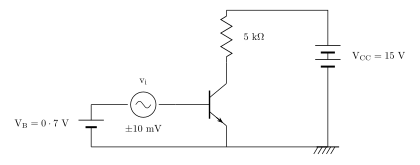
Consider the BJT amplifier circuit given below with the following parameters : d.c. current gain \beta_{\text{dc}} = a.c. current gain \beta_{\text{ac}} = 100 \text{I}_\text{B} = 20\ \mu\text{A} for \text{V}_\text{B} = 0\cdot 7\text{ V}, and \text{i}_\text{b} = \pm 2\ \mu\text{A} for \text{v}_\text{i} = \pm 10\text{ mV}. Determine the values of \text{V}_{\text{CE}}, input impedance and voltage gain \text{A}_\text{v}.
(i) Using the logic gates, draw the circuit diagram representing the Boolean expression \text{AB} + \text{A}(\text{B} + \text{C}) + \text{B}(\text{B} + \text{C}). (ii) Simplify the following Boolean expression : [\text{AB}(\text{C} + \overline{\text{BD}}) + \overline{\text{AB}}]\ \text{CD}
Explain Gell-Mann and Ne'eman SU(3) symmetry for the classification of elementary particles — baryons and mesons.
Why does a neutron star have a magnetic field if it is composed of neutrons?
What is the age of a fossil that contains 6\text{ g} of carbon {}^{14}\text{C} and has a decay rate of 27\text{ decays per minute} ? Given : Ratio \frac{{}^{14}\text{C}}{{}^{12}\text{C}} = 1\cdot 3 \times 10^{-13}, Half life (T_{1/2}) of {}^{14}\text{C} = 5730\text{ yrs}.
(i) K^+ \longrightarrow \Pi^+ + \Pi^+ + \Pi^- (ii) \Pi^+ + p \longrightarrow \Pi^+ + \Pi^+ + n (iii) \Pi^+ + p \longrightarrow \Delta^{++} \longrightarrow \Pi^+ + p (iv) \Sigma^\circ \longrightarrow \lambda^\circ + \gamma (v) \Sigma^+ \longrightarrow \lambda^\circ + e^+ + u_e (vi) K^- + p \longrightarrow K^+ + K^\circ + \Omega^- (vii) \Pi^\circ \longrightarrow \gamma + e^+ + e^- (viii) \Sigma^- \longrightarrow n + e^- + \bar{\nu}_e (ix) \lambda^\circ \longrightarrow p + e^- + \bar{\nu}_e (x) e^+ + e^- \longrightarrow \gamma + \gamma Name the interactions via which the above nuclear decays occur :
On the basis of conservation laws, explain whether the following reactions are allowed or forbidden : (i) \pi^- + \text{p} \longrightarrow \Sigma^+ + \text{K}^- (ii) \text{K}^- + \text{p} \longrightarrow \Omega^- + \text{K}^+ + \text{K}^0 (iii) \Omega^- \longrightarrow \Xi^0 + \pi^- (iv) \pi^+ + \text{p} \longrightarrow \text{p} + \text{p} + \bar{\text{n}} (v) \Sigma^+ \longrightarrow \Lambda^0 + \text{K}^+
What do you understand by nuclear forces ? Explain meson theory of exchange forces.
How could you establish that \nu_e and \bar{\nu}_e are two different particles ?
What do you understand by the critical size of a nuclear reactor? Write down the common features of nuclear reactors used for the production of electricity.
Justify the fact that the electrons are emitted from nuclei in \beta-decay but they cannot be contained inside the nuclei.
Establish the Rutherford's scattering cross section formula for \alpha-particle by considering the standard assumptions and symbols.
What do you understand by the critical size of a reactor ? Explain the main features of nuclear reactors.