Write equation for damped harmonic oscillations and obtain expression for logarithmic decrement. In a damped harmonic motion, the first amplitude is 10\text{ cm}, which reduces to 2\text{ cm} after 50 oscillations, each of period 4\text{ seconds}. Determine the logarithmic decrement. Also, calculate the number of oscillations in which the amplitude decreases to 25\%.
What are three and four level pumping schemes ? Explain the lasing action in these with schematic diagrams.
In the above experiment, a shift of 100 fringes is obtained when all the gas is removed from the tube. Calculate the refractive index of the gas if the wavelength of light used is 6000\text{ \AA} and the length of the tube is 10\text{ cm}.
Write conditions for working of a step-index optical fiber. In a step-index fiber, the core and cladding materials have refractive indices 1\cdot50 and 1\cdot43, respectively. Find the following : (i) Critical propagation angle (ii) Acceptance angle (iii) Total time delay in 1\text{ km} length of the fiber (iv) Total dispersion in 50\text{ km} length of the fiber
Consider the interaction of an electromagnetic wave at the interface of two dielectric media. If electric field \vec{E} is parallel to the plane of incidence, obtain Fresnel's equations and Brewster's law of polarization.
A length of 25 cm of a solution containing 50 gm of solute per litre causes a rotation of the plane of polarization of light by 5^\circ. Find the rotation of the plane of polarization by a length of 75 cm of the solution containing 100 gm of solute per litre.
Find an expression for the average energy of a forced oscillator in the steady-state motion.
Explain with proper examples the techniques of obtaining interference by 'division of wavefront' and 'division of amplitude'.
Obtain condition for achromatism of two thin lenses separated by a finite distance. If the dispersive powers of the materials of the two lenses are 0\cdot020 and 0\cdot028, their focal lengths are 10\text{ cm} and 5\text{ cm}, respectively. Calculate the separation between them in order to form achromatic combination.
(i) What are the requisite conditions for observation of interference pattern on a screen ? (ii) Derive the expression for fringe width and intensity at a point on the screen in a double slit experiment.
An achromatic doublet of focal length 25\text{ cm} is to be made by placing a convex lens of borosilicate crown glass in contact with a diverging lens of dense flint glass. Assuming n_r = 1 \cdot 61864, n_b = 1 \cdot 62468, n_r' = 1 \cdot 71426 and n_b' = 1 \cdot 72906, calculate the focal length of each lens. Here, the unprimed and the primed quantities refer to the borosilicate crown glass and dense flint glass respectively.
Explain an experiment for determination of the refractive index of a gas using Michelson interferometer.
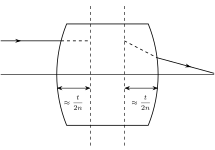
Consider a thick equiconvex lens of refractive index 1 \cdot 5 as shown in the figure. The magnitude of the radii of curvatures of the two surfaces is 5\text{ cm}. The thickness of the lens is 1\text{ cm} and the lens is placed in the air. Obtain the system matrix and determine the focal length and the position of unit planes :
(i) What is the difference between Fresnel diffraction and Fraunhofer diffraction ? (ii) What is resolving power of a telescope ? Why is the resolving power of microscope more with UV light than with visible light ?
A length of 25\text{ cm} of a solution containing 50\text{ gm} of solute per litre causes a rotation of the plane of polarization of light by 5^\circ. Find the rotation of the plane of polarization by a length of 75\text{ cm} of the solution containing 100\text{ gm} of solute per litre.
Define Einstein's coefficients A and B for spontaneous and stimulated emissions, and write the relation between them. If the Einstein's coefficient of spontaneous emission is 10^7/\text{s}, determine the Einstein's coefficients for the stimulated emission for the emission wavelength of 5800\text{ \AA}.
Calculate the inertia tensor for a rigid body consisting of three particles of masses 3\text{ gm}, 1\text{ gm}, 2\text{ gm} located at (1, -1, 2)\text{ cm}, (1, 0, 2)\text{ cm}, (-2, 1, 0)\text{ cm} respectively.
Calculate the inertia tensor for a rigid body consisting of three particles of masses 3 gm, 1 gm, 2 gm located at (1, -1, 2)\text{ cm}, (1, 0, 2)\text{ cm}, (-2, 1, 0)\text{ cm} respectively.
A hoop is rolling down on an inclined plane without slipping. Find its velocity at the bottom of the inclined plane.
(i) Prove that the separation of two colliding particles is same, when observed in centre of mass and laboratory systems. (ii) Determine the kinetic energy of a thin disc of mass 0\cdot5\text{ kg} and radius 0\cdot2\text{ m} rotating with 100 rotations per second around the axis passing through its centre and perpendicular to its plane.