The aperture width of a laser light source of wavelength 6000\text{ \AA} is 3\text{ mm} and its power is 20\text{ mW}. Calculate the light intensity at a distance of 200\text{ m} from the light source.
15 Marks
The aperture width of a laser light source of wavelength 6000\text{ \AA} is 3\text{ mm} and its power is 20\text{ mW}. Calculate the light intensity at a distance of 200\text{ m} from the light source.
Light of wavelength 6000\text{ \AA} is incident on a slit of width 0\cdot 40\text{ mm}. The screen is placed 2\text{ m} away from the slit. Find (i) the position of the first dark fringe and (ii) the width of the central bright fringe.
Find the required thickness of the calcite plate to convert plane polarized light (\lambda = 6000\text{ \AA}) into circularly polarized light. (For calcite, \mu_O = 1\cdot 658 and \mu_E = 1\cdot 486)
A monochromatic parallel beam of wavelength \lambda = 600\text{ nm} is incident on a single slit of width a = 0\cdot 3\text{ mm}. A convex lens of focal length f = 1\text{ m} forms the Fraunhofer diffraction pattern on a screen.
(i) Determine the angular width and linear width of the central maximum on the screen.
(ii) If the slit width is halved, explain quantitatively how diffraction pattern changes.
(iii) A second wavelength 450\text{ nm} is added. Will the minima of the two wavelengths coincide? Justify mathematically.
A particle executes simple harmonic motion of amplitude A and angular frequency \omega. A damping force proportional to velocity acts on the particle. Derive the expression for the displacement of the particle as a function of time and discuss the effect of damping on amplitude and frequency. Also, calculate the time at which the amplitude reduces to half its initial value, if the damping coefficient is b and mass is m.
Using Fraunhofer diffraction theory, derive the expression for the intensity distribution due to a circular aperture and obtain the condition for the first minimum. Using this result, derive the expression for the resolving power of an optical instrument. Finally, calculate the minimum angular separation that can be resolved by a telescope of aperture diameter D = 10\text{ cm} for light of wavelength 500\text{ nm}.
A uniform rod of length L and mass m stands vertically upright on a rough floor and then tips over. What is the rod's angular velocity when it hits the floor?
The energy of a photon is expressed as E = h\nu, where h is the Planck's constant and \nu is the frequency of the photon. The momentum of the photon is \frac{h\nu}{c}, where c is the speed of light. Show that if a photon scatters from a free electron (of mass m_e), the scattered photon has energy E' = E \left[ 1 + \frac{E}{m_e c^2} (1 - \cos\theta) \right]^{-1} where \theta is the angle through which the photon scatters. Also, show that the electron acquires a kinetic energy T = \frac{E^2}{m_e c^2} \left[ \frac{1 - \cos\theta}{1 + \frac{E}{m_e c^2}(1 - \cos\theta)} \right]
A cardiologist reports to her patient that the radius of the left anterior descending artery of the heart has narrowed by 10\%. What percent increase in the blood pressure is required to maintain the normal blood flow through this artery? Assume that the viscosity of the blood and the length of the artery remain unchanged.
Consider a particle of mass m in two dimensions experiencing a central force \vec{F} = -k\vec{r}, where k is a positive constant and \vec{r} is the radius vector of the particle relative to the force center.
(i) What is the angular momentum \vec{J} of the particle relative to the force center? Show that \vec{J} is conserved.
(ii) Write down the system of equations of motion in two dimensions in polar coordinates. Reduce this system to a one-equation problem and find the equation for the effective potential energy U_{\text{eff}}.
Consider a symmetric top of mass M, with its tip held fixed, rotating in a gravitational field. Assuming that the origins of the fixed and body coordinate systems coincide, determine the Lagrangian of the top. Are there any angular momenta which are conserved? If yes, find their expressions.
A pion at rest decays into a muon and a neutrino (see the figure) :
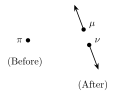
Find the velocity of the muon.
What is Josephson effect? How can Josephson junctions be used to produce macroscopic quantum interference?
In powder diffraction method pattern for lead with radiation of wavelength \lambda = 1\cdot 54 \text{ \AA}, the (220) Bragg reflection angle is \theta = 32^\circ. Find the radius of the atom.
(i) Explain the Bravais lattice and non-Bravais lattice with suitable diagram. (ii) Draw the (1\ 0\ 0), (1\ 1\ 0) and (1\ 1\ 1) planes in a cubic unit cell. (iii) Obtain the Miller indices of a plane with intercepts a, b/2, 3c in a simple cubic unit cell.
Consider an energy band which is filled with electrons up to a certain value k_1 \left(k_1 < \frac{\pi}{a}\right). Determine the total effective number of free electrons in the energy band. Comment on the electron distribution in an insulator, intrinsic semiconductor and metals at 0\text{ K}. Symbols have their usual meanings.
Find the radius of the interstitial sphere which can just fit into the void at the body centre of the \text{fcc} structure coordinated by the facial atoms.
What is X-ray diffraction? How is an XRD pattern used to determine the crystal structure of the material?
(i) Give a qualitative description of the BCS theory and explain how it accounts for the superconducting state. (ii) The critical field of niobium is 1 \times 10^5\text{ A/m} at 8\text{ K} and 2 \times 10^5\text{ A/m} at absolute zero. Find the transition temperature of the element.
Explain the cause of hysteresis phenomenon in ferromagnetic materials. What does the area of the hysteresis loop signify?