How can one convert a left-handed circularly polarised light into a right-handed one (and vice versa)? Calculate the thickness of a quarter-wave plate when the wavelength of light is 589\,\mathrm{nm}. Given: \mu_0 = 1.544 and \mu_E = 1.553.
10 Marks
How can one convert a left-handed circularly polarised light into a right-handed one (and vice versa)? Calculate the thickness of a quarter-wave plate when the wavelength of light is 589\,\mathrm{nm}. Given: \mu_0 = 1.544 and \mu_E = 1.553.
With a neat ray diagram, describe Fraunhofer diffraction at a circular aperture.
Why is population inversion in general not possible in a two-level laser system? Explain it.
Two Fabry -- Pérot interferometers have same plate separation but the coefficients of intensity reflection are 0\cdot 7 and 0\cdot 9. Deduce the relative width of the maxima in the above two cases.
A High Frequency (HF) radio receiver receives simultaneously two signals from a transmitter 400\text{ km} away, one by a path along the surface of the Earth, and the other by reflection from a portion of the ionospheric layer situated at a height of 200\text{ km}. We assume that the Earth is flat and the ionospheric layer acts as a perfect horizontal reflector, which is moving slowly in the vertical direction. When the frequency of the transmitted wave is 10\text{ MHz}, it is observed that the combined signal strength varies from maximum to minimum and back to maximum 6 times per minute. With what slow vertical speed is the ionospheric layer moving ?
How can the refractive index of a liquid be determined using a method of Newton's rings ? Obtain an appropriate expression for calculating the refractive index.
What are the fringes of equal thickness and fringes of equal inclination? In a Newton's ring arrangement with a source emitting two wavelengths \lambda_1=6\times10^{-7}\,\text{m} and \lambda_2=5.9\times10^{-7}\,\text{m}, it is found that the m^{\text{th}} dark ring due to one wavelength coincides with the (m+1)^{\text{th}} dark ring due to the other. Find the diameter of the m^{\text{th}} dark ring, if the radius of curvature of the lens is 90\,\text{cm}.
It is required that a real image twice the size of the object be formed by a thin plano-convex lens. If the lens has a radius of curvature of 50\text{ cm} and a refractive index of \mu = 1\cdot 5, determine the locations of the object and image with respect to the lens.
Prove that when light goes from one point to another via a plane mirror, the path followed by light is the one for which the time of flight is the least.
What is axial chromatic aberration? A convex lens has a focal length of 15.5 \times 10^{-2}\,\mathrm{m} for red colour and 14.45 \times 10^{-2}\,\mathrm{m} for violet colour. If an object is kept at a distance of 40\,\mathrm{cm} from the lens, calculate the longitudinal chromatic aberration of the lens.
The quality factor Q in a damped harmonic motion is defined as Q = \frac{2\pi \times \text{Average energy stored per cycle}}{\text{Average energy dissipated per cycle}} Show that Q = \frac{\omega}{2b} (where the symbols have usual meaning).
(i) Find the moments of inertia of rigid diatomic molecule about different axes of symmetry through the centre of mass.
(ii) A proton is 1837 times heavier than an electron. Find the centre of mass of hydrogen atom.
Consider a light beam passing through a horizontal column of water moving with a velocity 'v'. Determine the speed u of the light measured in the lab frame when the beam travels in the same direction as the flow of the water. (Speed of water = v (lab frame), and refractive index = n)
How fast and in what direction must galaxy A be moving if an absorption line found at wavelength 550\text{ nm} (green) for a stationary galaxy is shifted to 450\text{ nm} for galaxy A and how fast and in what direction is galaxy B moving if the same line is shifted to 700\text{ nm} for it ?
A particle moves in an elliptical orbit in an inverse-square-law central force field. If the ratio of the maximum angular velocity to the minimum angular velocity of the particle in the orbit is n, then show that the eccentricity of the orbit is \varepsilon = \frac{\sqrt{n} - 1}{\sqrt{n} + 1}.
Two \beta-particles A and B emitted by a radioactive source R travel in opposite directions, each with a velocity of 0.9c with respect to the source. Find the velocity of B with respect to A (Here c is the velocity of light).
A particle of mass m rests on a smooth plane. The plane is then raised to an inclination angle \theta at a constant rate \alpha (\theta = 0 at t = 0), causing the particle to move down the plane, as shown in the figure below.
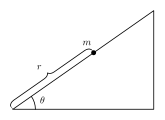
Write down the Lagrangian and determine the equations of motion. Solve the resulting equation for "r" to obtain the expression for r(t).
Show that the cross-section for elastic scattering of a point particle from an infinitely massive sphere of radius R is \dfrac{R^2}{4}. What is the inference of this result?