What do you understand by a perfect black body? Can it be realised in practice ? Show that the ratio of the emissive power to the absorptive power for all bodies at a given temperature is equal to the emissive power of a perfectly black body.
Show that the Poynting vector \bar{S} = (\bar{E} \times \bar{H}) represents the energy flow per unit area per unit time both in magnitude and direction in case of a plane electromagnetic wave.
A thin converging lens and a thin diverging lens are placed coaxially at a distance of 5 cm. If the focal length of each lens is 10 cm, find for the combination (i) the focal length, (ii) the power, (iii) the positions of the principal points.
Differentiates between Rayleigh and Raman scatterings. Why is Raman scattering considered to be a breakthrough in molecular spectroscopy ? What are the advantages of using laser light in Raman spectroscopy ?
Water vapor shows Infrared absorption bands at 1595\text{ cm}^{-1}, 3652\text{ cm}^{-1} and at 3756\text{ cm}^{-1}. If the Raman spectrum is observed with the Argon Ion Laser 514.5\text{ nm}, at what wavelengths would you expect to find the Raman Stokes lines ?
A quartz quarter wave plate is to be used with the sodium light (\lambda = 5896\text{ \AA}). What should be its thickness ?
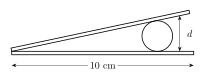
Two microscope slides of length 10 cm each form a wedge. At one end they are in contact and at the other end they are separated by a thin wire of diameter d (see the diagram below). Interference fringes are obtained when illuminated vertically by a monochromatic light of \lambda = 500\text{ nanometers}. The fringe spacing is found to be 1.25 cm. Estimate the diameter of the wire.
Show that the ratio of the focal lengths of the two lenses in an achromatic doublet is given by \frac{f_1}{f_2} = - \frac{w_1}{w_2} where w_1 and w_2 are the dispersive powers of the lenses of focal lengths f_1 and f_2 respectively.
A siren of frequency 900 Hz is going towards a wall away from an observer at a speed 10 m/sec. Determine : (i) Frequency of sound directly heard from the siren. (ii) Frequency of sound reflected from the wall. (iii) Number of beats per second heard by the observer. (Velocity of sound = 330 m/sec)
A narrow slit illuminated by monochromatic light of \lambda = 6400\text{ \AA} is placed at a distance of 3 metres from a straight edge. If the distance between the straight edge and the screen is 6 metres, calculate the distance between the first and the fourth dark bands.
Write down the equation of motion for a damped harmonic oscillator assuming the damping force proportional to the velocity of the particle. Obtain the general solution for its displacement as a function of time. Discuss the cases of 'overdamping', 'under-damping' and 'critical damping'.
For a freely falling body from the height h' on the surface of the earth in the northern hemisphere with a latitude \theta, show that the deviation of the body towards east at the final stage is given by \frac{1}{3} \omega \cos \theta \left(\frac{8h^3}{g}\right)^{1/2}, where \omega is the angular velocity of the earth and 'g' is the acceleration due to gravity.
If a single stage rocket is fired vertically from rest at the earth's surface burns its fuel in a time of 30 sec and their relative velocity = 3 km sec^{-1}, what must be the mass ratio m_0/m for a final velocity v of 8 km sec^{-1} ?
Write down the expression for the relativistic mass of a particle moving with a velocity v in terms of its rest mass. Establish from the above expression Einstein's mass-energy relation E = mc^2.
A particle moves in space with the Lagrangian L = \frac{1}{2} m (\dot{x}^2 + \dot{y}^2 + \dot{z}^2) - V + A \dot{x} + B \dot{y} + C \dot{z} where A, B, C are given functions of x, y, z. Find the corresponding Hamiltonian in terms of coordinates and momenta.
A meson of rest mass \pi comes to rest and disintegrates to a muon of rest mass \mu and a neutrino of zero rest mass. Show that the kinetic energy of motion of the muon is T = \frac{(\pi - \mu)^2 c^2}{2 \pi}
What do you mean by the moments and products of inertia ? Show that the angular momentum vector is related to the angular velocity components by linear transformation relations.
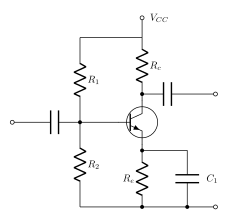
In the following circuit, Show that the stability factor, S, is given by
S = \frac{1 + \beta}{1 + \frac{\beta R_e}{R_e + R_b}} Where R_b = \frac{R_1 R_2}{R_1 + R_2}
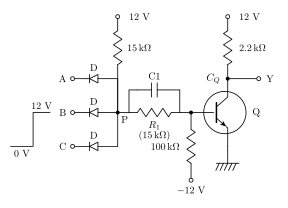
Explain the operation of the following circuit is a gate. Draw the truth table and find the operation carried out by this gate neglecting the source impedance.
junction saturation voltages and diode voltages in forward direction. Find the minimum value of h_{fe}.
(i) What are high T_c superconductors ? Give two examples indicating their transition temperatures. Differentiate between the conventional and high T_c super conductors. (ii) Explain the principle of feedback in an amplifier. What are the advantages & negate feedback?