(i) Treating CH molecule as an united atom, derive its resultant molecular electronic states. (ii) Calculate the moment of inertia of HCl molecule from the expression u_{\text{HCl}} = 20.68 (J+1), where J = 0, 1, 2, \dots
(i) A sample is irradiated by a 5000 \AA\ radiation to give a Raman line at 5050.5 \AA. Calculate the Raman frequency. (ii) Explain, both red and violet degraded bands have been observed in electronic band systems, but rotation-vibration spectra show bands degraded to red only.
(i) The wave function of a particle is . \psi(x) = A \exp \left( -\frac{x^2}{a^2} + i k_0 x \right) Find the expectation values of position (x) and momentum (p) for the particle. (ii) A 200 eV increase in the energy of an electron changes its De Broglie wavelength by a factor of two. Calculate the initial De Broglie wavelength of the electron.
Derive an expression for the electrical conductivity of metals on the basis of free electron theory of metals.
Distinguish between a classical and a quantum mechanical harmonic oscillator. Explain the existence of zero point energy.
Solve the one dimensional Schrodinger wave equation with potential: V(x) = \begin{cases} 0 & \text{for } x < -a \\ V_0 & \text{for } -a < x < a \\ 0 & \text{for } x > 0 \end{cases}
Derive the Bose-Einstein distribution for an ideal gas.
Discuss the phenomenon of Bose-Einstein condensation. Obtain the expression for the condensation temperature. Briefly comment on observation of Bose-Einstein condensate.
Describe Carnot cycle and show that efficiency is given by \eta = \frac{Q_1 - Q_2}{Q_1} = \frac{T_1 - T_2}{T_1} where the symbols have their usual meaning.
A bulb filament is constructed from a tungsten wire of length 2\text{ cm} and diameter 50\text{ }\mu\text{m}. It is enclosed in a vacuum bulb. What temperature does it reach when it is operated at a power of 1 watt? Given:
(i) Emissivity of tungsten \varepsilon = 0.4
(ii) Stefan's constant \sigma = 5.67 \times 10^{-8}\text{ watt/m}^2\text{ K}^4.
A Geiger tube consists of a wire a wire of radius 0.2\text{ mm} and length 12\text{ cm} and a co-axial metallic cylinder of radius 1.5\text{ cm} and length 12\text{ cm}. Find
(i) the capacitance of the system, and
(ii) the charge per unit length of the wire when the potential difference between the wire and the cylinder is 1.2\text{ kV}. (Assume the dielectric constant of the gas in the tube to be 1)
Show that the potential energy of a charge Q uniformly distributed throughout the sphere of radius R is given by PE = \frac{3}{5} \frac{Q^2}{4\pi\varepsilon_0 R}
A series LCR circuit with \mathrm{L} = 2\text{ H}, \mathrm{C} = 2\text{ }\mu\text{F} and \mathrm{R} = 20\\ \Omega is powered by a source of 100\text{ volts} and variable frequency. Find
(i) the resonance frequency, f_0,
(ii) the value of Q
(iii) the width of resonance \Delta f and
(iv) the maximum current at resonance.
Why did Maxwell have to introduce the idea of displacement current? Derive the wave equation from Maxwell's laws. Obtain Fresnel's formula for reflection and transmission coefficients of the electric vector when it is perpendicular to the plane of incidence.
Calculate the electric field for a point on the axis of a uniform ring of a charge 'q' and radius a. Show that the maximum value occur at x = \pm a/2.
What are vector and scalar potentials for the electromagnetic field? Are they unique? Explain what are Coulomb's and Lorentz gauges. Derive the electromagnetic wave equation in Lorentz gauge and show that it is equivalent to Maxwell's equation.
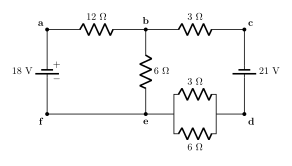
Using Kirchhoff's laws find currents in each branch of the circuit shown in the following diagram.
In an experiment using a Michelson interferometer, explain with the help of suitable ray diagrams.
(i) Why do we need extended source of light,
(ii) Why do we get circular fringes, and
(iii) Shifting of fringes inwards or outwards as we shift the movable mirror.
State Fermat's principle. Apply it to get the laws of reflection from a plane surface.
How do you know that the light is a transverse wave? What is a quarter wave plate? How is it constructed?
