2321cse-2000-subject-08-007
Paper II20 Marks
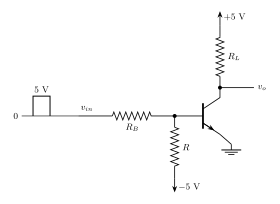
A circuit of a NOT gate is given in the figure below. Explain how you will determine the values of the resistances R_B, R and R_L.
Search, filter, and study UPSC Civil Services & IFoS Physics past year questions with rigorous derivations, formulas, and step-by-step solutions.

A circuit of a NOT gate is given in the figure below. Explain how you will determine the values of the resistances R_B, R and R_L.
Explain why superconductors are perfect diamagnets.
Which one of these mechanisms shows a negative dynamic resistance? Why?
Do these mechanisms have different temperature coefficients? Explain.
A Zener diode of 1\text{ W} power has a dynamic resistance of 10\text{ m}\Omega at the breakdown voltage of 3\text{ V}. What will be the fluctuations in the current through the diode if the voltage fluctuates by 100\text{ mV}? What will happen to the diode ? Why?
Discuss the different breakdown mechanisms for a reverse biased Zener diode.
What are the salient characteristics of ferromagnetic ? Explain how the Curie law of paramagnetism is modified to the Curie - Weiss law.
A nuclear reactor has an output power of 1\text{ MW} with a thermal efficiency of 30\%. How much uranium per day is consumed to run this reactor, if the average energy released per fission of ^{235}\text{U} is 200\text{ MeV}, and the uranium is enriched to 2\%\ ^{235}\text{U} ?
Which of the following reactions are allowed? What are the conservation laws violated by the rest ? Classify the particles (fermions / bosons. mesons / baryons, leptons/ hadrons) involved and the type of interactions in the case of the allowed ones. (i) \Sigma^0 \rightarrow \pi^+ + \pi^- (ii) \pi^- + p \rightarrow n + \pi^0 (iii) \pi^+ + p \rightarrow \pi^+ + p + \pi^- + \pi^0 (iv) \pi^0 \rightarrow \gamma + \gamma
How do you explain the continuous spectrum in beta decay of radioactive nuclei ?
Using the uncertainty principle, show that the electrons cannot exist inside the nucleus. How does then one account for the beta decay of a nucleus ?
A \mu (of mass 207\text{ m}) is in the ground state of a muonic atom whose nucleus is Pb (Z = 82, A = 204, and radius = 7\text{ fm}). Calculate the first Bohr radius in units of the nuclear radius and the Rydberg constant in units of the Rydberg constant in units of the Rydberg constant of the hydrogen atom. Comment on your results.
Determine all the Term symbols of p^2 equivalent electrons and arrange these states in increasing order of energy. Justify your answer.
Describe the Stern-Gerlach experiment and discuss its significance.
A 500\ \mu\text{A} beam of electrons of kinetic energy 1.5\text{ eV} enter a region with a sharply defined boundary in which their energy is reduced to 10\text{eV} by a difference of potential. Determine the reflected and transmitted currents. Derive the formulae used.
The momentum of an electron is 600\text{ keV/c}. Determine its de Brogue wavelength and the phase and group velocities of its de Brogue waves.
X-ray photons of wavelength 2.0\text{ pm} are incident on free electrons. They are scattered at an angle of 60^\circ from the incident direction. Determine the following: (i) Momentum of the incident photon in keV/c (ii) Compton shift (iii) Kinetic energy and recoil angle of the electron
Determine the eigenvalues and eigenfunctions of the operators D + 137, D^2 - 2xD + 4. where D = d/dx. Assume the eigenfunction of the second operator to be a quadratic.
Write a short note on Clausius-Clapeyron equation.
What is an adiabatic process? Give three engineering examples of adiabatic processes which are in common use.