2581cse-1995-subject-05-002
Paper II20 Marks
Using Heisenberg Uncertainty principle, calculate the mass of meson being exchanged between nucleons inside the nucleus, taking the range of nuclear force as 1.7 F. Distinguish between pion and muon.
Search, filter, and study UPSC Civil Services & IFoS Physics past year questions with rigorous derivations, formulas, and step-by-step solutions.

Using Heisenberg Uncertainty principle, calculate the mass of meson being exchanged between nucleons inside the nucleus, taking the range of nuclear force as 1.7 F. Distinguish between pion and muon.
An electron is confined in a one dimensional box 1 \text{\AA} width. Draw the energy level diagram upto three energy stats of also draw the corresponding normalized eigen function. Derive the expressions for eigen functions and eigen values used in the calculations. Show that eigen functions are othogonal.
Describe how Davisson-Germer electron diffraction experiment confirms the de Broglie hypothesis of matter wave.
Hydrogen and oxygen suffer Joule - Thomson expansion at room temperature. Discuss the results with reasons.
Write a short note on Brownian motion.
Calculate the most probable speed v_p, the avenge speed \langle v \rangle and the root-mean-square speed \langle v^2 \rangle^{1/2} for hydrogen molecules at 273\text{ K}.
Define thermodynamic temperature of a magnetic system. Discuss how cooling takes place due to adiabatic demagnetisation. Explain, why cooling due to adiabatic demagnetisation is important at low temperatures.
Write a short note on Concept of negative temperature.
Write the expressions obtained from Einsteins’s and Debye’s theories for the specific heat of solids. What is the basic difference between the two theories? Calculate the heat required to raise the temperature of a solid of mass m from T_1 to T_2 in the low temperature region.
State Nernst’s heat theorem. Taking the example of adiabatic demagnetisation show that no adiabatic process initiated at non-zero-temperature can lead to zero temperature.
Define entropy, Derive expressions for the entropy of a perfect gas in terms of (i) T and v (ii) T and p The symbols have their usual meanings.
Starting from Maxwell equations obtain differential equations for scalar and vector potentials. Choosing the required gauge obtain identical differential equations for scalar and vector potentials. Solve the equation for scalar potential in a dielectric medium having a source of charge density p.
Show that the Amperes circuital law fails for time varying currents. How has this difficulty been overcome by Maxwell by introducing the concept of displacement current density? How is the expression for \vec{A} \times \vec{B} modified for magnetized material for magnetisation vector \vec{M} ?
The solar constant on the lighted surface of the earth is given as ‘J’ Assuming solar radiation as black body radiation find an expression for the temperature of the photosphere of the sun.
An electric dipole is placed in an external electric field. Find the interaction energy between the electric dipole and the field. And hence find the force and the torque acting on the dipole.
How does a ferromagnetic material get magnetized? Why is the demagnetization process irreversible? What is the physical significance of the magnetic hysteresis loop for a ferromagnetic material? Under what conditions the ferromagnetic materials become paramagnetic ?
An alternating voltage of varying frequency is applied across a two-branch parallel circuit of R_1 and L in series and R_2 and C in series as shown in Fig. below.
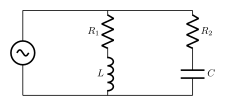
Find its resonant frequency. If R_1 and R_2 are not zero, state the conditions when the resonant frequency is given by f_0 = \frac{1}{2\pi \sqrt{LC}}
What is the synchronization condition in a cyclotron? Under identical magnetic flux density, show that the kinetic energy of an accelerated \alpha-particle is equal to that of proton. What should be the frequencies of r.f. electric fields for \alpha-particles and proton, respectively placed under the same magnetic flux density?
An alternating voltage is applied to CR circuit connected in series. Under what conditions it acts as an (i) integrator and (ii) a differentiator?
Discuss the working principle of He-Ne laser indicating the transitions involved in the process. Determine the power output of a laser in which a 3.0\text{ J} pulse is delivered in 1.0\text{ ns}.