2961cse-1987-subject-04-001
Paper I20 Marks
Starting from van der Waals equation for a gas, deduce expressions for its critical temperature, critical pressure and critical volume.
Search, filter, and study UPSC Civil Services & IFoS Physics past year questions with rigorous derivations, formulas, and step-by-step solutions.

Starting from van der Waals equation for a gas, deduce expressions for its critical temperature, critical pressure and critical volume.
Write a note on Anomalous dispersion.
What is dielectric susceptibility? Describe how you can determine the radius of an atom from the measurement of the dielectric constant of a gas. A parallel plate condenser consists of two plates of area 400\text{ sq. cm.} each separated by a sheet of material of 0.10\text{ mm} thickness. Find the capacity in microfarads when the dielectric constant of the material is 5.0.
In an oscillatory circuit L = 0.30\text{ henry} and C = 1.2 \times 10^{-6}\text{ F,} determine the value of maximum resistance so that the circuit may remain oscillatory.
Write down Maxwell s equations for the electromagnetic field in Free space and show that \vec{E} satisfies the wave equation. Hence obtain the expression for the velocity of e.m. waves in free space.
Obtain an expression for the force exerted on unit volume of a paramagnetic substance in a non-uniform magnetic field. How could you experimentally distinguish and diamagnetic and paramagnetic substance?
Derive an expression for the mean energy \varepsilon of a Planck oscillator in thermal equilibrium with the surroundings. How does the ratio h\nu / kT vary as the temperature T varies from \leqslant h\nu / k to \leqslant h\nu / k, the symbols having the usual meanings?
Monochromatic light of wavelength due to diffraction, and critically; comment on \textit{[Source text is incomplete in the available scan.]}
The equation for displacement of point on a damped oscillator is given by x - 5e^{-0.2t} \sin \frac{\pi}{2}t \text{ metre} Find the velocity of the oscillating point at t = \frac{T}{4} and T_p where T is the time-period of the oscillator.
Fourier analyse the step-function f(x) = 1 \text{ for } 0 < x < \pi = -1 \text{ for } \pi < x < 2\pi and hence prove that 1 + \frac{1}{9} + \frac{1}{25} + \frac{1}{49} + \dots = \frac{\pi^2}{8}
A beam of light of wavelength 5.82 \times 10^{-7}\text{ m} falls normally on a glass wexge with the wedge angle of 20''. If the refractive index of glass is 1.5, find the number of dark interference fringes per centimetre of the wedge length.
Write a note on Oscillations with two degrees of freedom.
Derive an expression for the resolving power of a diffraction grating.
The speeds v of waves on the surface of a liquid is given by v = \sqrt{\frac{TK}{P} + \frac{g}{k}} where T is the surface tension of the liquid of density P > K = 2\pi / \lambda, \lambda being the wavelength of the wave and g is acceleration due to gravity Find the wavelength and frequency of waves on water which move with minimum speed.
Monochromatic light of wavelength 6.56 \times 10^{-7}\text{ m} falls normally on a grating 2.00\text{ cm} wide. The first order spectrum is produced at an angle of 18^\circ15' from the normal. Deduce the total number of lines in the grating.
Plane waves pass through a slit whose plane is parallel to the wave fronts. Obtain an expression for the angular spread of the central maximum due to diffraction, and critically comment on the result.
State Huygen's principle and on its basis establish Snell's law of refraction of light. How does the result differ from what Newton's Corpuscular theory gave?
The mean distance of the Earth from the Sun is 1.496 \times 10^{11}\text{ m}, while that of Saturn is 1.427 \times 10^{12}\text{ m}. Find the time taken by Saturn to complete one revolution round the Sun.
Find the linear acceleration of the center of gravity of a uniform disc which rolls down an inclined plane without slipping. The angle of inclination is 30^\circ.
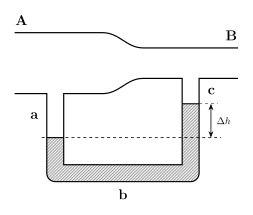
Air is blown through a pipe AB, at a rate of 15\text{ litres per minute}. The area of cross-section at A is 2\text{ cm}^2 whereas at B it is 0.2\text{ cm}^2. A tube abc, containing some water, is connected as shown. Find the difference in height, \Delta h, between the levels of water in the tube abc.