781cse-2019-subject-08-007
Paper II15 Marks
Sketch the cross-sectional structure of an enhancement mode MOSFET and explain its principles of operation with the help of its output characteristics.
Search, filter, and study UPSC Civil Services & IFoS Physics past year questions with rigorous derivations, formulas, and step-by-step solutions.

Sketch the cross-sectional structure of an enhancement mode MOSFET and explain its principles of operation with the help of its output characteristics.
A superconducting material has a critical temperature of 3\cdot 7~\text{K} and a magnetic field of 0\cdot 0306~\text{tesla} at 0~\text{K}. Find the critical field at 2~\text{K}.
Obtain the Boolean expression for the output Y in the given logic circuit :
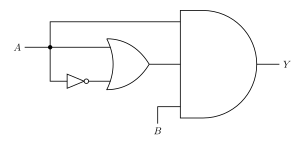
Simplify the expression and show that the circuit is equivalent to an AND gate with inputs A and B.
A silicon semiconductor sample at T=300\,\mathrm{K} having cross-sectional area of 0.5\,\mu\mathrm{m}^2 has a pentavalent donor doping profile given by C(x)=5\times10^{16}e^{-x/L_n}\,\mathrm{cm^{-3}}. Given, the mobility of the electrons in the sample is 1250\,\mathrm{cm^2\,V^{-1}\,s^{-1}} and the diffusion length of the electrons, L_n, is 4\,\mu\mathrm{m}. Calculate the diffusion current in the sample at distance x=2\,\mu\mathrm{m}.
Explain the Meissner effect in superconductivity. Obtain an expression for London penetration depth of magnetic field for a superconductor.
Given that the single particle energy separation between 1d_{5/2} and 1d_{3/2} in ^{17}\mathrm{O} is 5\,\mathrm{MeV}. Calculate the strength of spin-orbit interaction. It is observed that 1d_{5/2} level is lower than 1d_{3/2} level.
Assuming equal masses for up (u) and down (d) quarks, find the ratio (\mu_n/\mu_p) of the magnetic moments of neutron and proton.
Stable light nuclei have equal number of protons and neutrons, whereas heavy nuclei have excess of neutrons. Explain why.
In the following nuclear reactions, what particles are possible for the unknown particle X?
(i) \pi^- + p \rightarrow K^0 + X
(ii) p + p \rightarrow \pi^+ + n + \Lambda^0 + X
Explain the various methods of finding the size of the nucleus. How will you determine the nuclear radius from the observation of beta rays resulting from nuclear transition when the initial and final nuclei are mirror nuclei?
What are the properties of the particles made up of the following quarks? Also write the names of particles :
(i) u\bar{d}
(ii) \bar{u}d
(iii) dds
(iv) uss
What do you understand by the reproduction factor of a fission reactor? What is the maximum value of the reproduction factor in a uranium fission reaction?
For a system consisting of one proton and one neutron (not necessarily a deuteron), write down the various possible states specifying clearly its isospin, spin and orbital quantum numbers.
On the basis of liquid-drop model, write the semi-empirical mass formula for the total binding energy. Also explain their each term.
By applying the conservation laws, state about the following decay equations, whether they are allowed or not allowed :
(i) \Sigma^+ \rightarrow p + \pi^0
(ii) \Sigma^0 \rightarrow \Lambda^0 + \gamma
(iii) \Lambda^0 \rightarrow n + \pi^0
Explain the origin of the nuclear magnetic moment. Deduce expression for the magnetic dipole moment with the help of the Schmidt single particle model.
Calculate the decay rate of ^{14}\text{C} per gram of carbon in a living organism, assuming the ratio ^{14}\text{C} / ^{12}\text{C} = 1\cdot 35 \times 10^{-12}. The half-life of ^{14}\text{C} is 5730 years.
Why is it not possible to detect the parity violation in weak interaction by observing only the beta decay rate? Justify your answer.
Explain the salient features of nuclear shell model. What are the magic numbers? Write the experimental facts in support of shell model of nuclei.
What is Lamb shift? Discuss its significance in determining the fine structure of \mathrm{H}_{\alpha} Balmer line in hydrogen atom.