Define Fermi energy and show that for an electron gas at absolute zero temperature, the Fermi energy is given by E_F = \left( \frac{h^2}{2m} \right) \left( \frac{3}{8\pi} \frac{N}{V} \right)^{2/3} where the symbols have their usual meanings. Estimate the numerical value of Fermi energy for copper taking number of electrons per unit volume as 8\cdot 4 \times 10^{22}\text{ electrons/cm}^3 and find Fermi temperature T_F.
Write Bose-Einstein distribution function explaining every symbol. Derive Einstein's result on specific heat of solids explaining the assumptions made in the model. Discuss the low and high temperature limits of the predicted specific heat. In which limit, the Einstein formula fails to explain the experimental data?
Schematically, show the variation of density of states, D(\varepsilon) and distribution function, f(\varepsilon,T), of particles in a non-relativistic Fermi gas at high temperatures. At a temperature T, an electron occupies a state with energy 100\mathrm{meV} above the Fermi energy (\varepsilon_{\mathrm F}) with the probability of 1\%. Find the temperature T.
Show that the probability of occupation for an electron state at the Fermi energy is equal to 0\cdot 5 for all finite temperatures.
A system having two energy levels, -\frac{1}{2}\Delta and +\frac{1}{2}\Delta with \Delta=10\mathrm{meV} is populated by 1000 particles at a low temperature close to 100\ \mathrm{K}. Obtain the average energy per particle using classical distribution law.
Consider N molecules of a gas obeying van der Waals' equation of state given by \left( P + \frac{a N^2}{V^2} \right) (V - Nb) = N k_B T where a is a measure of the attractive forces between the molecules and b is another constant proportional to the size of the molecules. The other symbols have their usual meanings. Show that during an isothermal expansion from volume V_1 to volume V_2 quasi-statically and reversibly, the work done is W = -N k_B T \log \left( \frac{V_2 - Nb}{V_1 - Nb} \right) + a N^2 \left( \frac{1}{V_1} - \frac{1}{V_2} \right)
One mole of a gas obeys the following equation of state: \left(P + \frac{a}{v^{2}}\right)(v-b)=RT, where v is the molar volume and, a and b are constants. Show that internal energy of the gas increases as the volume increases, with the temperature remaining constant.
Explain Maxwell-Boltzmann formula for distribution of velocities of gas molecules at temperature T. What will be the formula for distribution of speeds? If \bar{v}, v_{\text{rms}} and v_m denote average speed, root mean square velocity and most probable speed, show that \bar{v} : v_{\text{rms}} : v_m = \sqrt{\frac{8}{\pi}} : \sqrt{3} : \sqrt{2}
At 4^{\circ}\mathrm{C} temperature, the density of water is found to be maximum. Prove that heat capacity at the constant pressure (c_p) is equal to the heat capacity at constant volume (c_v) for water at 4^{\circ}\mathrm{C}.
If the temperature variation of heat capacity is known, how do you calculate the change of entropy during an isochoric process? According to Debye's theory of specific heat of a solid, the molar heat capacity of diamond crystal at constant volume varies with temperature (T) as follows: c_v=\frac{12}{5}\pi^{4}R\left(\frac{T}{\Theta}\right)^{3} where R is the molar gas constant =8.315\ \mathrm{J/mol\ K} and \Theta=2230\ \mathrm{K} for diamond. Calculate the change in entropy of diamond of 0.36 g mass when it is heated at constant volume from 0 K to 300 K.
Starting from the first law of thermodynamics, show that C_p - C_v = \left[ P + \left( \frac{\partial U}{\partial V} \right)_T \right] \left( \frac{\partial V}{\partial T} \right)_P
The pressure on 100 g of solid copper is increased quasi-statically and isothermally at 0^\circ\mathrm{C} from 0 to 0.5 \times 10^{8}\ \mathrm{Pa}. Assuming the density and isothermal compressibility to remain at constant values of 8.96\ \mathrm{g/cm^3} and 7.16 \times 10^{-12}\ \mathrm{Pa^{-1}}, respectively, calculate the work done. Comment on the sign and magnitude of work.
State and explain Biot-Savart law. Obtain an expression for the magnetic field at the center of a circular loop of radius r metres, carrying a current of I amperes.
Obtain an expression for the electric potential and electric field strength at a point due to an electric dipole.
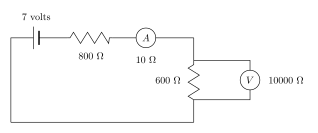
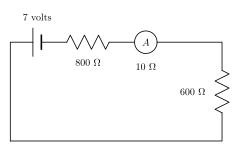
Two resistors of 600~\Omega and 800~\Omega are connected in series with a 7\text{ volts} battery. An ammeter of 10~\Omega resistance is used to measure current.
(i) What will be the reading in the ammeter?
(ii) Similarly if a voltmeter of 10000~\Omega resistance is used to measure the potential difference across the 600~\Omega resistor, what will be the reading in the voltmeter?
Explain Planck's formula for black-body radiation. Use this formula to show that energy radiated per unit time per unit area in the range d\lambda of \lambda is e(\lambda, T) = \left( \frac{2\pi c^2 h}{\lambda^5} \right) (e^{\beta hc / \lambda} - 1)^{-1} d\lambda
What are the limitations of Rayleigh-Jeans law in explaining the spectrum of radiations from a blackbody? Explain how these limitations were overcome in Planck's radiation law. Deduce Wien's displacement law from Planck's radiation law.
Define a plane electromagnetic wave. A plane polarized wave is incident on the interface between two dielectric media. Obtain expressions for the amplitudes of the reflected and transmitted waves when the incident wave is polarized with its electric field B vector perpendicular to the plane of incidence. Discuss the phase relationships of the reflected and transmitted waves with respect to the incident wave.
A 12.0 V battery is connected at t=0 to a series combination of a resistor R=10.0\Omega and an inductor L=5.0\mathrm{H}. At what rate is energy being stored in the inductor when the current in the circuit is 0.4 A?
There is a potential gradient of 100\text{ V/m} normal to the surface of the earth. Assuming the earth to be a charged sphere of radius 6370\text{ km}, find the total charge on the earth.