1501cse-2013-subject-03-001
Paper I15 Marks
Using the fundamental concepts of electromagnetism, determine the electric field of an electric dipole \vec{p} at a distance \vec{r} and its energy in an electric field \vec{E}.
Search, filter, and study UPSC Civil Services & IFoS Physics past year questions with rigorous derivations, formulas, and step-by-step solutions.

Using the fundamental concepts of electromagnetism, determine the electric field of an electric dipole \vec{p} at a distance \vec{r} and its energy in an electric field \vec{E}.
ABCD is a rectangle in which charges of +10^{-11}\,\mathrm{C}, -2\times10^{-11}\,\mathrm{C} and 10^{-11}\,\mathrm{C} are placed at corners B, C and D, respectively.
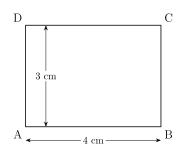
Calculate the potential at the corner A and the work done in carrying a charge of 2 coulombs to A.
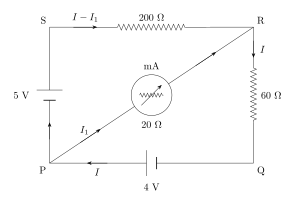
In the circuit diagram shown below, calculate the current passing through the milliammeter.
Consider the equation for a series RLC circuit and compare this to the parallel resonant circuit shown below:
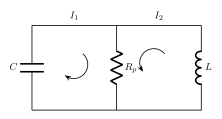
Calculate the value of R_p if a series RLC circuit and the parallel RLC circuit are to have same equations for the potential of capacitance while they both have the same L, C and Q with Q being the total charge.
A series LCR circuit has resonant frequency \omega_0 and a large quality factor Q. Write down in terms of R, \omega, \omega_0 and Q, its (i) impedance at resonance, (ii) impedance at half-power points and (iii) the approximate forms of its impedance at low and high frequencies.
Consider the following coupled inductor - capacitor circuit:
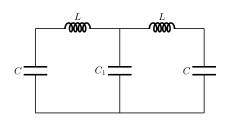
Calculate the ratio of the frequencies of the anti-symmetric and symmetric modes \omega_a/\omega_s. \left(\text{Given } k=\frac{1}{LC},\ k'=\frac{1}{LC_1}\right)
With reference to ferromagnetic materials, explain the terms hysteresis and hysteresis loops.
(i) Considering an isotropic, linear, non-conducting, non-magnetic and inhomogeneous dielectric medium with \vec{D}=\epsilon\vec{E}=\epsilon_0n^2(x,y,z)\vec{E}, show that the electromagnetic wave equation for the field \vec{E} is given by \nabla^2\vec{E}+\vec{\nabla}\left(\frac{1}{n^2}\vec{\nabla}n^2\cdot\vec{E}\right)-\mu_0\varepsilon_0n^2\frac{\partial^2\vec{E}}{\partial t^2}=0. \setcounter{enumi}{1}
(ii) Write down the scalar equation for E_x from the above equation.
(iii) Interpret physically the situation if we move from homogeneous to an inhomogeneous medium.
(iv) Obtain the similar vector equation for the magnetic field \vec{H} in inhomogeneous medium.
Define a black body. How can we realise a black body in practice ? Derive expression for Planck's radiation law.
Show that Wien's law and Stefan-Boltzmann law are limiting cases of Planck's radiation law.
Using Poisson equation and spherical co-ordinates, calculate the density of continuous charge distribution that will provide the Yukawa potential \phi = \frac{\exp(-\alpha r)}{r}, where \alpha is a constant.
The electric field of a plane e.m. wave travelling along the z-axis is \vec{E}=(E_{0x}\hat{x}+E_{0y}\hat{y})\sin(\omega t-kz+\phi). Determine the magnetic field.
If a thin sheet of glass of thickness t and refractive index \mu is placed in the path of one of the interfering waves, show that the distance through which a fringe is displaced is a function of t.
Discuss the applications of lasers in communication and medicine.
Explain the lasing action of \text{He}-\text{Ne} laser using energy level diagram and describe the operation of \text{He}-\text{Ne} laser experimental set-up.
A block of mass m is attached to one end of a combination of two massless springs connected in series. The other end of the combination is fixed to a rigid support. The spring constants of the two springs are k_1 and k_2, respectively. The block is free to move on a frictionless horizontal surface. If the block is pulled a little and then released, calculate the frequency of oscillation of the block.
A parallel beam of light from a He--Ne laser (\lambda=630 nm) is made to fall on a narrow slit of width 0.2\times10^{-3} m. The Fraunhofer diffraction pattern is observed on a screen placed in the focal plane of a convex lens of focal length 0.3 m. Calculate the distance between the \begin{qroman}\item first two minima and \item first two maxima on the screen.\end{qroman}
Explain the physical significance of resolving power of a grating with relevant mathematical expression.
Consider a zone plate with radii r_n = 0\cdot 11 \sqrt{n}\text{ cm} illuminated by a monochromatic light of wavelength 589\text{ nm}. Calculate the positions of first two foci.
Discuss spatial evolution of Fresnel diffraction into Fraunhofer diffraction.