Show that the magnitudes of the centripetal and Coriolis accelerations of the earth while rotating counter-clockwise about the north pole are around 0\cdot 034\text{ m sec}^{-2} and (1\cdot 46 \times 10^{-4} v)\text{ m sec}^{-2}, respectively. In obtaining these results, consider the ratio of sidereal days to solar days in a year as (366\cdot 5/365\cdot 5) and the radius of the earth along the equator as 6400\text{ km}.
A type-II superconducting material with superconducting transition temperature T_c is placed in a magnetic field. What is the material state (normal or superconducting or mixed) for (i) T < T_c ; \quad H > H_{c_2} (ii) T > T_c ; \quad H < H_{c_1} (iii) T < T_c ; \quad H_{c_1} < H < H_{c_2} (iv) T < T_c ; \quad H < H_{c_1} (v) T > T_c ; \quad H > H_{c_2} where H_{c_1} and H_{c_2} are the lower and upper critical fields for a type-II superconductor.
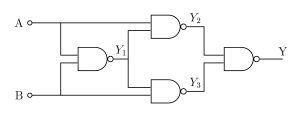
Verify that the circuit shown below is an exclusive OR.
What is Meissner effect ? Explain the conclusions drawn from the Meissner effect.
The resistance of silicon and germanium varies with temperature. But these are not used normally as thermistors. Why ? Name at least two widely used materials for making thermistors and give any five applications of thermistor.
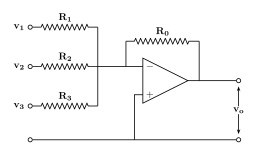
List the characteristics of an ideal OP-AMP. Write the expression for the output voltage in terms of input voltages and resistance values.
What do you understand by early effect in bipolar junction transistors ? What are its consequences ? Discuss briefly the advantage of using the BJT in the common collector configuration.
Silicon is the most popular semiconductor material used for the fabrication of electronic devices and integrated circuits. Why ? Give at least five reasons.
Which of the waves out of (i) X-rays, (ii) de-Broglie waves due to electrons or neutrons will be suitable for crystal diffraction ? Justify your answer in terms of energies of these waves for 0 \cdot 1 \text{ nm}.
Show that the reciprocal lattice of a hexagonal lattice is a hexagonal lattice with a rotation of axes.
Write down the Yukawa potential and derive an expression for the mass of \pi-meson in terms of range of nuclear force. What part of the Nucleon – Nucleon interaction is explained by this potential ?
What is the simplest two-nucleon bound system ? How does its study help in obtaining information about nuclear forces ? Indicate clearly how the non-central forces can be explained by the observed magnetic moment of this system.
Compare the methods of electron scattering and neutron scattering experiments to obtain information about nuclear size.
What are the field quanta of weak and electromagnetic interactions ? Show that weak interaction is a short range force while electromagnetic interaction is a long range one.
Identify all the spin-half particles in the following list : Antineutron, Antiproton, Muon, Muon Neutrino, Neutral Kaon, Neutral Sigma, Neutral Xi, Neutron, Photon, Positive Pion, Positron, Proton, u-quark.
At what energies, do we anticipate the unification of strong and electroweak interactions ? What will happen to coupling constants of these interactions in this situation ? How does unification indicate the decay of proton and existence of leptoquark ?
What was the aim of Stern – Gerlach experiment ? Why were silver atoms chosen instead of electrons in the experiment ? What was the outcome of the experiment ?
Explain Born – Oppenheimer approximation. Discuss the intensity distribution in the vibrational electronic spectra of a diatomic molecule on the basis of Franck – Condon principle.
Discuss the vibrational spectra of a diatomic molecule treating it as a harmonic oscillator as well as an anharmonic oscillator and compare them.
(i) Find the ground state total orbital (L) and total spin (S) quantum numbers for nitrogen. (ii) Find the L and S values of the two "first excited states" of helium atom.