At very low temperatures, the specific heat of rock salt varies with temperature according to the Debye T^3 law. The Debye temperature for rock salt is 281\text{ K}. How much heat will be required to raise the temperature of 2\text{ kilo-mol} of rock salt from 10\text{ K} to 50\text{ K}?
What is diamagnetism? Why do diamagnetic materials have negative magnetic susceptibility?
Discuss the limitations of the quantum theory of diamagnetism.
What are the different methods used to increase the probability of exposure for the atomic planes with right orientation to X-rays in the X-rays diffraction studies?
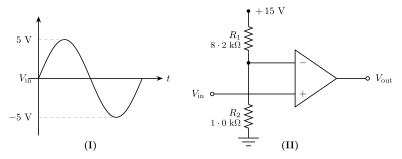
The input signal as shown in Figure (I) is applied to the comparator circuit given in Figure (II). Make a sketch of the output signal showing its proper relationship to the input signal. Assume that the maximum output levels of the op-amp are \pm 12\text{ V}.
What is the photovoltaic effect? What are the processes that are required to obtain a useful power output from photon interactions in a semiconductor? List the factors that affect the efficiency of a solar cell.
Explain the principle and working of the Laue's diffraction method. Comment on the origin of Laue spots and the utility of Laue's diffraction pattern.
Discuss the Debye model of lattice specific heat. What are the limitations of the Debye model?
What are the physical reasons that the effective mass of an electron can be infinite and negative?
The energy near the valence band edge of a crystal is given by E = -10^{-39} k^2\text{ J}\cdot\text{m}^2. An electron with wave vector 10^{10}\hat{k}_x\text{ m}^{-1} is removed from an orbital in the completely filled valence band. Determine its effective mass and momentum.
Explain briefly the two-fluid model proposed by the London brothers and obtain the expressions for the penetration depth and the number of superelectrons in a superconducting specimen.
What is the effective mass of an electron?
Draw a diagram of magnetic susceptibility as a function of temperature. Pay attention to the relative scales in your diagram so that the relative strengths of the magnetic phenomena are presented.
In powder diffraction method pattern for lead with radiation of wavelength \lambda = 1\cdot 54 \text{ \AA}, the (220) Bragg reflection angle is \theta = 32^\circ. Find the radius of the atom.
What are the differences in electrical characteristics of FET (JFET) and MOSFET?
What is X-ray diffraction? How is an XRD pattern used to determine the crystal structure of the material?
Find the radius of the interstitial sphere which can just fit into the void at the body centre of the \text{fcc} structure coordinated by the facial atoms.
Explain the cause of hysteresis phenomenon in ferromagnetic materials. What does the area of the hysteresis loop signify?
Classify diamagnetic, paramagnetic and ferromagnetic materials in terms of their magnetic susceptibility (\chi). Plot and explain the variation of \frac{1}{\chi} with temperature for the three materials.
How does n-channel FET differ from p-channel FET?