The density of a liquid monovalent metal near absolute zero temperature is given to be 0\cdot 081\text{ g cm}^{-3}. Calculate the Fermi energy \varepsilon_F, the electron velocity v_F at the Fermi surface and the Fermi temperature T_F.
10 Marks
The density of a liquid monovalent metal near absolute zero temperature is given to be 0\cdot 081\text{ g cm}^{-3}. Calculate the Fermi energy \varepsilon_F, the electron velocity v_F at the Fermi surface and the Fermi temperature T_F.
(i) What is the concept of effective mass of the electron ? (ii) The energy near a valence band edge is given by E(k) = -1 \times 10^{-26} k^2\text{ ergs}. An electron is removed from the orbital k = 1 \times 10^7 k_x\text{ cm}^{-1}. Find the sign and magnitude of effective mass of the hole.
How does supercritical magnetic field depend on temperature ? For a superconducting specimen, the critical magnetic fields are respectively 1\cdot 45 \times 10^5\text{ A/m} and 4\cdot 2 \times 10^5\text{ A/m} for 14\text{ K} and 13\text{ K}. Determine the superconducting transition temperature and the critical field at 0\text{ K}.
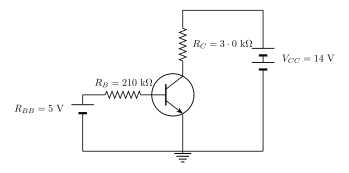
The n\text{-}p\text{-}n transistor given below has \beta = 100, I_{CO} = 12\text{ nA} and V_{BE} = 0\cdot 8\text{ V}. Determine the transistor currents and the region of operation of the transistor. What happens if R_C is indefinitely increased?
Compare the working of FET and MOSFET with their structure, I-V curve and transfer characteristics.
(i) What is the origin of paramagnetism ? Discuss the temperature dependence of paramagnetic susceptibility. (ii) Calculate the diamagnetic susceptibility of atomic Hydrogen in the ground state at STP. Assume the mean square distance of electronic charge distribution of atomic Hydrogen from the nucleus r^2 = 3 a_0^2, a_0 being the radius of the first Bohr orbit of Hydrogen.
Assume that the range of the interaction of nuclear force and of meson is 2 \times 10^{-15}\text{ m}. Estimate the mass of the meson.
Compare nuclear density of hydrogen (_1\text{H}^1) with its atomic density. (Assume the atom to have the radius of its first Bohr orbit). What inference can one get from the above comparison ?
Does the nucleus possess magnetic moment ? Justify your answer. Define nuclear magneton (\mu_{\text{N}}) and Bohr magneton (\mu_{\text{B}}). Calculate their values.
(i) Write semi-empirical mass formula. Calculate the atomic number (Z) of most stable nucleus for given mass number (A) using the above formula. (Use the value of fitted coefficients for Coulomb energy a_3 = 0\cdot 711\text{ MeV} and that for asymmetry energy a_4 = 23\cdot 702\text{ MeV}). (ii) Calculate the Q-value of the following nuclear reaction : _4\text{Be}^9 + {}_2\text{He}^4 = {}_6\text{C}^{12} + {}_0\text{n}^1 Given : the mass of neutral atoms of \text{Be}, \text{He} and \text{C} are 9\cdot 015060, 4\cdot 003874 and 12\cdot 003815\text{ amu}, respectively. The mass of neutron is 1\cdot 008986\text{ amu}.
What is nuclear resonance absorption of gamma rays ? Describe the working and applications of Mossbauer spectrometer.
Write the decay reactions of the neutral pions (\pi^0) and the charged pions (\pi^+, \pi^-).
For the ground state of deuteron, prove that the radius of nucleon is of the order of \sim 2\cdot 15 \times 10^{-13}\text{ cm}.
What were the difficulties faced by the initial theory of \beta-decay? How did Pauli eliminate the difficulties? What were the expected properties of the new particle proposed by Pauli?
What is meant by strength of the interactions of elementary particles ? Classify the different forces on the basis of this strength of interaction.
(ii) From a study of the radial part of the Schr"{o}dinger equation of a deuteron for any angular momentum l, what do we conclude?
In the case of deuterons, answer the following : (i) What percentage of the time do the nucleons of a deuteron spend within the range of the nuclear forces?
A radionuclide (N_1) decays to a radioactive daughter (N_2) that subsequently decays to a third daughter (N_3). If at t = 0, the initial concentrations of N_1, N_2 and N_3 are N_1^0, 0 and 0 respectively, and the decay constants are \lambda_1 (from N_1 \rightarrow N_2) and \lambda_2 (from N_2 \rightarrow N_3), then derive the expression for N_2 at time t. Given that the daughter N_3 is stable.
Apply the meson theory of nuclear forces to write the interaction between protons, neutrons, proton to neutron and neutron to proton.
A sample contains 4\text{ mg} of ^{210}\text{Bi}. If the half-life of radioactive ^{210}\text{Bi} is 5\text{ days} and the average energy of the \beta-particles emitted is 0\cdot 34\text{ MeV}, then at what rate does the sample emit energy?