A body moves about a point ‘O’ under no force, the principal moments of inertia at ‘O’ being 3A, 5A and 6A. The components of the initial angular velocity about the principal axes are \omega_1 = n, \omega_2 = 0 and \omega_3 = n. Find the components \omega_1, \omega_2 and \omega_3 for large values of time t.
$
Consider a large stationary cylinder of inner radius R. A smaller solid cylinder of radius r rolls without slipping inside the larger cylinder. Determine the equation of motion of the smaller cylinder.
A solid shaft of mass M, length l and radius r is to be replaced by a lighter hollow shaft of the same length l and having the same ratings of \tau/\theta, where \tau is the couple and \theta is the angle of twist. Estimate the percentage reduction in mass of the hollow shaft if the outer radius of the shaft is twice the inner radius. Assume the material of the new shaft is same as that of the replaced shaft.
A particle of mass \text{m} moves under the attractive central force \text{F} = -\frac{\text{C}}{\text{r}^{\text{n}+1}}. Find the condition for which the particle will have stable circular orbit. (\text{C} > 0, a constant).
Derive the expression for the gravitational self-energy of a uniform solid sphere of mass M and radius R.
Write down the Euler equations for torque-free motion of a rigid body. Solve these equations to find precessing motion for a symmetric top.
A cube of mass M and side ‘a’ is rotating with angular velocity \omega around one of its edges, which is, say, along the x-axis. Obtain the expressions for its angular momentum and kinetic energy. (Given that the I_{XX} = \frac{2}{3} Ma^2, I_{YX} = -\frac{1}{4} Ma^2 and I_{ZX} = -\frac{1}{4} Ma^2)
(i) Define cyclic coordinates and find their connections with the symmetries of the system.
(ii) A system with two degrees of freedom is described by the Lagrangian \text{L} = \frac{1}{2}\text{m}_1 \dot{\text{q}}_1^2 + \frac{1}{2}\text{m}_2 \text{q}_1^2 \dot{\text{q}}_2^2 - \frac{\alpha}{\text{q}_1}, \alpha is constant. Find the cyclic coordinates, conserved quantities and symmetries for this system, if any.
How does supercritical magnetic field depend on temperature ? For a superconducting specimen, the critical magnetic fields are respectively 1\cdot 45 \times 10^5\text{ A/m} and 4\cdot 2 \times 10^5\text{ A/m} for 14\text{ K} and 13\text{ K}. Determine the superconducting transition temperature and the critical field at 0\text{ K}.
(i) What is the concept of effective mass of the electron ? (ii) The energy near a valence band edge is given by E(k) = -1 \times 10^{-26} k^2\text{ ergs}. An electron is removed from the orbital k = 1 \times 10^7 k_x\text{ cm}^{-1}. Find the sign and magnitude of effective mass of the hole.
The density of a liquid monovalent metal near absolute zero temperature is given to be 0\cdot 081\text{ g cm}^{-3}. Calculate the Fermi energy \varepsilon_F, the electron velocity v_F at the Fermi surface and the Fermi temperature T_F.
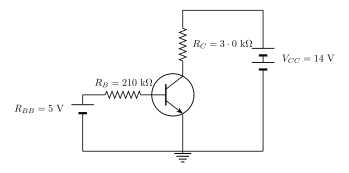
The n\text{-}p\text{-}n transistor given below has \beta = 100, I_{CO} = 12\text{ nA} and V_{BE} = 0\cdot 8\text{ V}. Determine the transistor currents and the region of operation of the transistor. What happens if R_C is indefinitely increased?
The spacing between successive (100) planes in sodium chloride is 1\cdot 41\text{ \AA}. X-rays incident on the surface of the crystal are found to give rise to second order Bragg reflections at a glancing angle 10^\circ. Calculate the wavelength of X-ray radiations.
Consider the planes with indices (1\ 0\ 0) and (0\ 0\ 1); the lattice is f.c.c., and the indices refer to the conventional cubic cell. What are the indices of these planes when referred to the primitive axes : \vec{a}_1 = \frac{a}{2}(\hat{x}+\hat{y}), \vec{a}_2 = \frac{a}{2}(\hat{y}+\hat{z}) and \vec{a}_3 = \frac{a}{2}(\hat{z}+\hat{x})?
(i) What is the origin of paramagnetism ? Discuss the temperature dependence of paramagnetic susceptibility. (ii) Calculate the diamagnetic susceptibility of atomic Hydrogen in the ground state at STP. Assume the mean square distance of electronic charge distribution of atomic Hydrogen from the nucleus r^2 = 3 a_0^2, a_0 being the radius of the first Bohr orbit of Hydrogen.
State the characteristics of an ideal Op-Amp. Explain the use of an Op-Amp as a summing amplifier and a differentiator.
Given that for intrinsic Si at T = 300\text{ K}, the band gap is 1\cdot 1\text{ eV} and the intrinsic carrier concentration is n_i = 1\cdot 5 \times 10^{10}\text{ cm}^{-3}. (i) Calculate the intrinsic carrier concentration at T = 450\text{ K}. Assume that the band gap at T = 450\text{ K} is 1\cdot 08\text{ eV}.
An RC-coupled transistor amplifier has mid-frequency gain A_{\text{vm}} = 100. The values of the lower and upper cut-off frequencies are f_1 = 20\text{ Hz} and f_2 = 50\text{ kHz}. Find the frequencies at which the gain is reduced to 80.
Compare the working of FET and MOSFET with their structure, I-V curve and transfer characteristics.