What do you understand by negative temperature? Write and explain various restrictions on a system for the concept of negative temperature to be meaningful.
15 Marks
What do you understand by negative temperature? Write and explain various restrictions on a system for the concept of negative temperature to be meaningful.
A current sheet having \vec{K} = 9.0a_y\,\mathrm{A\,m^{-1}} is located at z = 0. The interface is between the region 1, z < 0, \mu_{r1} = 4, and region 2, z > 0, \mu_{r2} = 3. Given that \vec{H}_2 = 14.5a_x + 8.0a_z\,\mathrm{A\,m^{-1}}. Find \vec{H}_1 and \vec{B}_1.
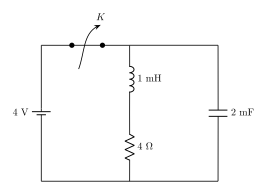
Consider the R-L-C circuit shown here. Calculate the Q-factor of the circuit. Does the circuit have a resonant frequency? Justify your answer:
A metal guitar string with a length of 70\,\mathrm{cm} vibrates at its fundamental frequency of 246.94\,\mathrm{Hz} in a uniform magnetic field of 10\,\mathrm{T} oriented perpendicular to the plane of vibration of the string. Assume a sinusoidal form for the amplitude of the vibrational mode, and a maximum displacement of 3\,\mathrm{mm} at the centre of the string. What is the maximum e.m.f. generated across the length of the guitar string, and at what point in time in the string's motion does that occur? What would be the e.m.f. if the same guitar string vibrates at its second harmonic frequency? Briefly explain.
A solid copper sphere of mass 100\text{ g} kept at 300\text{ K} is suspended inside a closed chamber. The walls of the chamber are kept at 0\text{ K}. Assuming that the sphere acts as a blackbody, calculate the time required for its temperature to drop to half of the initial value. (Given that density of copper is 8\cdot 96 \times 10^3\text{ kg m}^{-3}, its specific heat capacity is 389\text{ J kg}^{-1}\text{ K}^{-1})
Two dipoles 1 and 2 with dipole moments \vec{\text{p}}_1 = -\,5\,\hat{\text{z}}\text{ nC.m} and \vec{\text{p}}_2 = 9\,\hat{\text{z}}\text{ nC.m}, respectively, are located at points (0, 0, -\,2) and (0, 0, 3), respectively. Find the potential at the origin.
A cell of internal resistance 1\,\text{ohm}, 1.5 volt e.m.f. and another cell of internal resistance 2\,\text{ohm}, 2 volt e.m.f. are connected in parallel across the ends of an external resistance of 5\,\text{ohm}. Find the current in each branch of the circuit.
The potential at the surface of a sphere (radius R) is given by \text{V}_0(\theta) = \text{k} \cos 3\theta, where k is a constant. Find the potential inside the sphere.
Starting from the Laplace's equation in a cylindrical polar coordinate system and using the method of separation of variables, obtain the differential equations for the solutions of r, \phi and z components of the potential.
Write down Maxwell's equations in a non-conducting medium with constant permeability and susceptibility (\rho = j = 0). Show that \vec{E} and \vec{B} each satisfies the wave equation, and find an expression for the wave velocity. Write down the plane wave solutions for \vec{E} and \vec{B}, and show how \vec{E} and \vec{B} are related.
Consider an L-R-C series circuit with a 300\text{ mH} inductor, a 0\cdot 47\,\mu\text{F} capacitor and a 500\,\Omega resistor. The source has terminal rms voltage \text{V}_{\text{rms}} = 100\text{ V} and variable angular frequency \omega. For what two values of the angular frequency, \omega_1 and \omega_2, is the rms current half the resonance value ? Also calculate the resonance width |\omega_1 - \omega_2|.
A relativistic charged particle moves in the space occupied by uniform and mutually perpendicular electric and magnetic fields \vec{\text{E}} = \text{E}_0\,\hat{\text{x}} and \vec{\text{B}} = \text{B}_0\,\hat{\text{y}}, respectively. The particle moves rectilinearly along the z-direction. Find \vec{\text{E}}' and \vec{\text{B}}' in the reference frame moving translationally with the particle.
A long straight wire of circular cross-section is made of non-magnetic material (\chi_{\text{m}} = 1^\circ to a good degree of approximation). It is of radius a. The wire carries a current I which is uniformly distributed over its cross-section. Compute the energy per unit length stored in the magnetic field contained within the wire.
In a partially conducting medium, \varepsilon_r = 18.5, \mu_r = 800 and \sigma = 1\ \mathrm{S\,m^{-1}}. Find \alpha, \beta, \eta and the velocity u, for a frequency of 10^9\ \mathrm{Hz}. Determine \vec{H}(z,t). Given, \vec{E}(z,t) = 50e^{-\alpha z}\cos(\omega t - \beta a_z)a_y\ \mathrm{V\,m^{-1}}.
Consider two point particles of charge q each, separated by a distance d, and travelling at non-relativistic velocity \vec{v}. If the line joining the two charges is perpendicular to \vec{v}, then write an expression for the magnetic force between the two particles, and illustrate the direction of the force on each particle.
A wire in the form of a hexagon is just enclosed by a circle of radius 10\text{ cm}. If the current in the wire is 1\text{ A}, find the magnetic field at the centre of the hexagon. What would be the direction of the field if the current flows in the anti-clockwise direction ?
Consider a medium with an electric current density \vec{\text{J}}, permittivity \varepsilon and conductivity \sigma, which is described by Ohm's law \vec{\text{E}} = \sigma \vec{\text{J}}. Write down Maxwell's equations in such a medium. Using these equations, derive the wave equation for the electric field \vec{\text{E}}. Show that plane waves of the form \vec{\text{E}} = \vec{\text{E}}_0 \text{ e}^{\text{i}(\omega\text{t} - \text{kx})}, where \vec{\text{E}}_0 is a constant vector, are solutions of the wave equation but with complex k. Determine the explicit expression for k in terms of \varepsilon, permeability \mu_0, \sigma and the angular frequency \omega.
The spectral energy density curve of the moon shows maxima at 14\,\mu\text{m}. Estimate the temperature of the moon and the energy density of the lunar radiation.
A phase retardation plate of quartz has thickness 0.1436\,\mathrm{mm}. For what wavelength in the visible region will it act as quarter-wave plate? Given that \mu_{O}=1.5443 and \mu_{E}=1.5533.
What is forced oscillation ? Write its equation of motion and obtain the general solution. Discuss the condition for the resonance.