A tuning fork A produces 6 beats per second with another tuning fork B of frequency 508\text{ Hz}. When the prongs of A are loaded with a little wax, number of beats heard are 4 per second. Find the frequency of A before it was loaded with wax.
Obtain the system matrix for a thick lens and derive the thin lens formula.
State Fermat's principle. Using this principle, establish the Snell's law of refraction.
Show that the mean kinetic and potential energies of non-dissipative simple harmonic vibrating systems are equal.
What do you understand by missing orders in a double-slit diffraction pattern ? Obtain condition for missing orders in a double-slit Fraunhofer diffraction pattern, if the slit width and the separation between the slits are equal. In a double-slit diffraction experiment, if the slit widths are 0\cdot 20\text{ mm} and they are 0\cdot 10\text{ mm} apart, find the missing orders.
A transmission hologram is recorded in a medium of refractive index 1\cdot 15. If the spacing between the two consecutive maxima is 557\text{ nm} and the angle of incidence of reference and object waves from the reference axis (say z-direction) is 30^\circ, find the wavelength of the light source.
The coherence length and the bandwidth of a light source is 3\text{ km} and 1 \times 10^{-5}\text{ nm}, respectively. Determine its wavelength and the pulse duration.
A phase retardation plate of quartz has thickness 0.1436\,\mathrm{mm}. For what wavelength in the visible region will it act as quarter-wave plate? Given that \mu_{O}=1.5443 and \mu_{E}=1.5533.
Newton's rings are observed between a spherical surface of radius of curvature 100 cm and a plane glass plate. The diameters of 4th and 15th bright rings are 0.314 cm and 0.574 cm, respectively. Calculate the diameters of 24th and 36th bright rings and also the wavelength of light used.
In He-Ne laser, what is the function of He gas? Explain the answer with the help of energy level diagram for He -- Ne laser.
Discuss the phenomenon of birefringence in a crystal. What do you understand by positive and negative crystals ? If the refractive indices of a calcite crystal for E-ray and O-ray are 1\cdot 488 and 1\cdot 658, respectively, then calculate the thickness of the crystal for which it can work as
(i) quarter wave plate,
(ii) half wave plate. (Wavelength of the light is 5890\text{ \AA})
In a Newton's ring experiment, explain the following :
(i) Why are the fringes circular ?
(ii) Why is the central spot dark as seen by reflection ?
(iii) How can one obtain Newton's ring with bright centre ?
Consider the force-free motion of a symmetrical rigid body with z-axis as its axis of symmetry. Write down Euler's equations. Integrate them and obtain the solutions. On the basis of the obtained solutions show that the total angular velocity \vec{\omega} of such a rigid body is constant in magnitude and precesses about the z-axis with a constant frequency, say \Omega. Determine \Omega.
Define moment of inertia and radius of gyration of a body of mass M rotating about an axis. State and prove Parallel Axis theorem on moment of inertia.
A particle P of mass m_1 collides with another particle Q of mass m_2 at rest. The particles P and Q travel at angles \theta and \phi, respectively, with respect to the initial direction of P. Derive the expression for the maximum value of \theta.
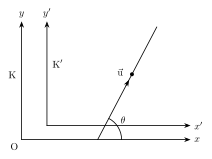
A particle of rest mass \text{m}_0 is moving in a stationary frame K with a velocity \vec{\text{u}} making an angle \theta with the x-axis as shown in the figure.
Find the corresponding angle \theta' made by the velocity vector of the particle with the \text{x}' axis in the frame \text{K}' that is moving with respect to K along the x-direction at a constant speed V.
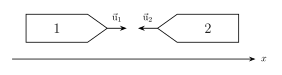
Two spaceships are approaching each other as depicted below.
Spaceship 1 is moving with a velocity \vec{\text{u}}_1 = 0\cdot 7\text{c }\hat{\text{x}}, while spaceship 2 is moving with a velocity \vec{\text{u}}_2 = -\,0\cdot 8\text{c }\hat{\text{x}} as measured by the stationary observer on Earth. Here, c is the velocity of light in vacuum and \hat{\text{x}} is the unit vector along the x-axis.
(i) What, according to Galilean addition of velocity, is the speed of spaceship 2 with respect to spaceship 1 (in terms of c) ?
(ii) What, according to relativistic addition of velocities, is the speed of spaceship 2 with respect to spaceship 1 (in terms of c) ?
(iii) Spaceship 1 emits a light signal towards spaceship 2. The observer on spaceship 2 measures the frequency of the light signal to be 10^{16}\text{ Hz}. What was the original frequency of the light signal ?
Two spaceships approach each other, both moving with same speed as measured by a stationary observer on the Earth. Their relative speed is 0.7c. Determine the velocity of each spaceship as measured by the stationary observer on the Earth.
Show that for very small velocity, the equation for kinetic energy, K=\Delta mc^2 becomes K=\dfrac{1}{2}m_0v^2, where notations have their usual meanings.
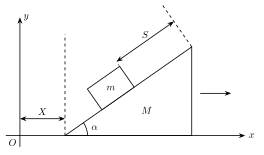
A small block of mass m slides without friction down a wedge-shaped block of mass M and opening angle \alpha as depicted below.
The wedge-shaped block itself slides along the horizontal frictionless floor along the +\text{ve x-direction}. Find the horizontal acceleration \ddot{\text{X}} = \text{d}^2\text{X}/\text{dt}^2 of the wedge-shaped block by the Lagrangian method and using the displacements \text{X} and \text{S} of the blocks as generalized coordinates.